
Responsibility Matrix: KPMG vs Roll With Paid for Cannabis Employers

For cannabis dispensaries and cultivations that need to limit joint employer risk and stay audit ready, we built Roll With Paid around exactly that problem. We specialize in high-risk payroll and HR, so the question isn’t which generalist firm to trust, but which contract terms actually shift liability. Ask for a responsibility matrix before you sign anything.
TL;DR:
- The strength of a payroll or EOR contract depends on detailed responsibility matrices outlining hiring, firing, recordkeeping, and liability allocation.
- The IRS and DOL guidelines clarify that liability remains with the employer unless the provider holds active CPEO certification and meets joint employer criteria.
- Delegating Form I-9 completion does not absolve the employer from verifying accuracy or retaining records, making operational controls essential.
- Sector-specific risk factors, including OSHA hazards and workers’ compensation, require clear contract ownership to avoid unaddressed facility and employee safety liabilities.
- Choosing a provider with specialized cannabis industry knowledge ensures compliance with state filings, HR practices, and audit readiness, reducing surprises at inspection time.
Table of Contents
- Quick checklist: what to verify in an EOR/payroll contract before you sign
- Payroll, tax, and employer of record realities: what IRS and DOL rules mean for you
- Onboarding and I-9s: delegation, liability, and audit-ready processes
- Safety, recordkeeping, and workers’ compensation: how HR links to facility risk in cannabis operations
- Author perspective: why industry specialization matters for high-risk employers
- Roll With Paid: a direct solution, what we do and what to ask next
- FAQ
- Sources
Quick checklist: what to verify in an EOR/payroll contract before you sign
A payroll or Employer of Record agreement is only as strong as the specific obligations it assigns. The label on the cover page means little if the body of the contract leaves hiring, firing, and recordkeeping duties vague.
Before signing, request documentation that answers these questions directly:
- Who holds hiring, firing, scheduling, and recordkeeping authority, mapped line by line in a responsibility matrix.
- Whose EIN is used to file employment tax returns, and whether the provider holds active CPEO certification.
- Written, state-specific confirmation of unemployment insurance accounts and workers’ compensation coverage in every state where you operate.
- How Form I-9 completion is delegated, who retains records, and what access you get during a government audit.
- What happens to payroll continuity, data, and employee records if the contract ends.
Pro Tip: Ask your provider to walk through a sample audit scenario with you before you sign, not after a Department of Labor letter arrives.
Our Employer of Record model is built to answer each of these items in writing, not just in a sales call.
Payroll, tax, and employer of record realities: what IRS and DOL rules mean for you
The terms “EOR” and “PEO” describe a business relationship, not a guaranteed liability shift. What actually determines who answers for a wage claim or a tax notice is the specific language in your contract, read against two bodies of federal rule.
The IRS’s guidance on third-party payer arrangements explains that a Certified Professional Employer Organization can be treated as the employer for federal employment tax purposes when it pays wages under its own EIN and holds active CPEO status. Without that certification, your business may retain more tax exposure than the sales brochure suggests.
Separately, the Department of Labor’s joint employer rule applies a four-factor test: who hires and fires, who supervises and controls schedules or conditions, who determines pay, and who maintains employment records. Meeting enough of those factors can create joint and several liability regardless of what your vendor calls itself.
The practical test for whether liability actually moved is operational control and contract specifics, not the name on the service agreement.
That’s why we ask every prospective client to compare our written responsibility matrix against these two frameworks before moving forward.
Onboarding and I-9s: delegation, liability, and audit-ready processes
Delegating Form I-9 completion to an authorized representative does not remove your liability as the employer. USCIS guidance is explicit that the employer remains responsible for verification accuracy and proper retention, even when someone else handles the paperwork.
Before you rely on any provider’s onboarding promise, confirm these operational safeguards in writing:
- Quality control steps for catching and correcting I-9 errors before they become audit findings.
- Secure, retrievable storage that meets retention rules and survives a staffing change at the vendor.
- Direct access for you (or a federal auditor) to pull records on short notice.
- Controls over payroll fund handling and time and attendance data that reduce cash and fraud exposure.
Our I-9 and E-Verify guidance for cannabis employers walks through each of these checkpoints in practice.
Safety, recordkeeping, and workers’ compensation: how HR links to facility risk in cannabis operations
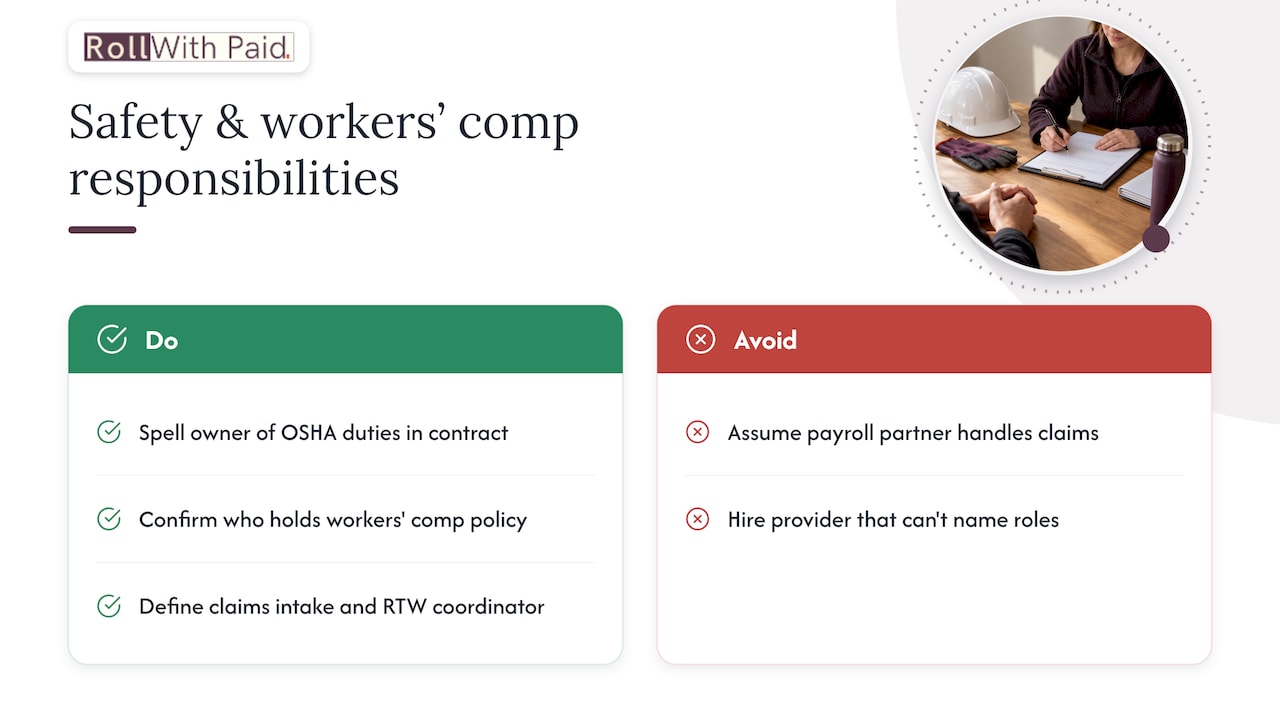
Cultivation and processing facilities carry hazards, chemical exposure, dust and allergen loads, heat, and extraction risks, that OSHA’s enforcement guidance treats as integral to recordkeeping obligations, not separate from them. When supervision is shared between your business and a payroll partner, incident reporting and OSHA 300 log maintenance need a clear owner spelled out in the contract.
The same clarity applies to workers’ compensation: confirm who holds the policy, who manages claims intake, and how return-to-work coordination happens after an injury. A provider that cannot answer these questions specifically is asking you to carry risk it hasn’t named. Our HR compliance guidance for dispensaries and cultivators covers how we document these splits for clients.
Author perspective: why industry specialization matters for high-risk employers
Generalist payroll providers tend to treat cannabis clients like any other retail business, and that mismatch shows up fastest in missed state filings and confused workers’ comp claims. Specialization isn’t a marketing line here. It means a provider has already built the state-by-state confirmations, the I-9 quality control steps, and the OSHA coordination that a generic contract template skips. Fewer surprises at audit time come from that groundwork being done before you ever sign, not from promises made during the pitch.
— Leah
Roll With Paid: a direct solution, what we do and what to ask next
Our services are built around the exact checklist above, not around a generic payroll template. Where traditional providers hesitate to touch cannabis accounts, some specialized providers document responsibilities in writing from the start.

What we offer:
- Employer of Record services with a written responsibility matrix for hiring, firing, and recordkeeping.
- Payroll execution built around cannabis-specific tax and cash handling constraints, including 280E awareness.
- Multi-state hiring support with state-by-state unemployment and workers’ compensation confirmation.
- I-9 and onboarding controls with quality checks and audit-ready retention.
- Time and attendance tools, informed by integration practices like those detailed in Kloqk’s audit-ready payroll guide, paired with workers’ comp coordination through policy partners such as South Lake Agency.
Before your next call with any provider, ask for a sample contract, a responsibility matrix, and a transition plan. Review our service rate and HR retainer details to see what fits your headcount and risk profile.
FAQ
Is Roll With Paid a CPEO or an EOR for cannabis businesses?
Our model operates as an Employer of Record arrangement where responsibilities are defined through a written agreement rather than assumed from a label. Ask us directly for the responsibility matrix and any relevant certification status before you compare that to a vendor’s CPEO claims under IRS third-party payer rules.
What does Roll With Paid cost compared to other payroll providers?
Pricing is based on a service rate plus an optional HR retainer, with costs varying depending on worker classification and headcount; no fixed published price is provided. You can review current pricing details directly before requesting a quote tailored to your operation.
Who is legally the employer for tax and unemployment reporting?
The answer depends on whether the provider holds active CPEO certification and whether it files under its own EIN, as described in IRS guidance on third-party payer arrangements. Without that certification or explicit contract language, your business may retain more employment tax liability than expected.
Does delegating I-9 completion remove our liability as the employer?
No. USCIS guidance states that delegating the task to an authorized representative does not eliminate the employer’s responsibility for accuracy and retention. You remain accountable even when a payroll partner handles the paperwork.
How do the DOL joint employer factors apply to dispensaries?
The Department of Labor’s four-factor test looks at who hires and fires, controls schedules, sets pay, and maintains records, and dispensaries that share supervision with a payroll vendor should map each factor against their contract. Meeting several factors can create joint and several liability regardless of the vendor relationship’s name.
Sources
These primary sources back the compliance points covered above and are worth bookmarking alongside your contract files.
- U.S. Department of Labor Issues Final Rule To Update FLSA’s Joint Employer Regulations | U.S. Department of Labor
- Third party payer arrangements – Professional Employer Organizations | Internal Revenue Service
- Completing section 2 (employer review and attestation) | USCIS I-9 Central
- OSHA enforcement directive on recordkeeping and hazards
Recommended
- What Is an Employer of Record — and Why It Matters for Your Benefits
- I-9 and E-Verify: A Compliance Guide for Cannabis Employers
- 280E and Payroll: What Cannabis Employers Need to Understand
- 5 Payroll Mistakes Cannabis Businesses Can’t Afford
Roll With Paid. is not a law firm and does not provide legal advice. This article summarizes Minnesota law as of August 2026 and is general information only. Tip arrangements are fact-specific; before changing a policy, consult employment counsel or contact DLI Labor Standards at 651-284-5075.