
High Times Magazine Relaunched in 2026, Featuring Leah Kollross
High Times is active again. After a stretch in receivership, the brand was purchased by RAW Rolling Papers founder Josh Kesselman and relaunched with quarterly collectible print issues and a daily-publishing website. Contributors such as Leah Kollross, who has been published in High Times, now write for the revived outlet, and legacy readers can find fresh reporting alongside archival back issues.
TL;DR:
- The relaunch emphasizes a return to cannabis advocacy and culture, with a focus on high-quality, collectible quarterly print issues rather than frequent newsstand editions.
- Legacy issues remain valuable to collectors, especially those from the 1970s and early editions, with condition and rarity driving pricing on the secondary market.
- The new ownership aims to rebuild credibility by re-engaging experienced contributors and restoring the magazine’s original focus on policy, cultivation, and countercultural reporting.
- Digital publication continues daily, but the print issues are curated and limited, prioritizing scarcity and historical significance over volume and broad reach.
- The brand’s revival reflects a shift back towards cultural authority and long-form journalism in cannabis media, differentiating it from newer, product-focused outlets.
Table of Contents
- Founding and Publication History
- Cultural Significance in Cannabis Culture and Journalism
- Why High Times Declined and How the 2025 Relaunch Happened
- Is High Times Still Published, and Where Can You Get It?
- Are Old High Times Magazines Worth Money?
- Notable Contributors and Editors Who Shaped High Times
- What the Revival Signals for Cannabis Media’s Future
- Why an HR and Payroll Specialist Follows High Times’ Reporting
- Notable Articles That Shaped Public Perception of Cannabis
- How High Times Compares to Other Cannabis Publications
- Who Reads High Times, and How That Audience Changed
- How High Times Shaped Cannabis Marketing and Advertising
- What This Revival Means If You Work in Cannabis
- FAQ
- Sources
Founding and Publication History
High Times launched in 1974, built by Tom Forçade as an advocacy magazine that treated cannabis culture as worthy of serious journalism rather than a punchline. The timing mattered: prohibition was near-total, and a glossy magazine openly covering cultivation, policy, and lifestyle was itself an act of defiance.
Circulation climbed through the late 1970s and into the 1980s and 1990s, with the title becoming a fixture on newsstands even in states where cannabis use carried criminal penalties. Editors over the decades shaped distinct eras: some leaned into investigative advocacy journalism, others pushed the magazine toward lifestyle and event coverage as the cannabis market itself changed shape.
Ownership and financial trouble followed in the 2000s. The brand drifted from its original focus during a period of business missteps, and by the mid-2010s the parent company was carrying debt that outpaced revenue. That slide culminated in receivership, a legal process where a court-appointed receiver manages a company’s assets because it cannot meet its obligations. The brand sat in that state until it was purchased and relaunched in 2025, with the new ownership group moving the print product to a quarterly, collectible format rather than attempting a return to frequent newsstand publishing.
Here is the shape of that timeline:
- 1974: Tom Forçade founds High Times as a cannabis advocacy and culture magazine.
- Late 1970s to 1990s: Circulation peaks; the magazine becomes a cultural fixture despite prohibition.
- 2000s: Ownership changes and editorial drift away from the core cannabis focus strain the business.
- Mid-2010s: Mounting debt and mismanagement push the parent company toward insolvency.
- 2024 to 2025: The brand moves through receivership and is purchased by Josh Kesselman and partners.
- 2025 to 2026: High Times reopens publishing with a quarterly collectible print model and an active editorial website.
| Era | Format | Defining trait |
|---|---|---|
| 1974 to 1990s | Monthly print | Advocacy journalism and counterculture coverage |
| 2000s to 2010s | Monthly print, declining frequency | Editorial drift, financial strain |
| 2024 to 2025 | Receivership, paused print | Ownership transition |
| 2025 to 2026 | Quarterly collectible print plus daily web | Relaunch under Kesselman ownership |
The pattern is clear across five decades: the magazine thrives when it stays close to cannabis culture and struggles when it wanders.
Cultural Significance in Cannabis Culture and Journalism
High Times earned its reputation by refusing to treat cannabis prohibition as settled law. From the outset, the magazine positioned itself as a defiant voice pushing against criminalization at a time when few mainstream outlets would touch the subject, and cultural critics have pointed to that defiance as the reason the brand outlasted competitors that treated cannabis coverage as a novelty.
That stance made the magazine a hub for countercultural writers, photographers, and illustrators who had few other outlets willing to publish their work. Its reach extended into music scenes that overlapped with cannabis culture, and the magazine’s event arm, including the Cannabis Cup competitions, turned readers into an actual community rather than a passive audience.
A few threads run through that legacy:
- Advocacy journalism: coverage of arrests, policy fights, and legalization efforts long before most newsrooms would run the stories.
- Artistic platform: a consistent outlet for writers and visual artists tied to counterculture movements.
- Event creation: competitions and gatherings that built community loyalty beyond the printed page.
As legalization spread state by state, the mainstreaming of cannabis changed what High Times could offer that competitors could not. When dispensaries and brand marketing normalized the plant, the magazine’s advocacy voice became less singular, even as its archive of early reporting remained historically significant.
Pro Tip: If you want to understand how cannabis culture shifted from underground to retail, read High Times issues from the 1980s alongside recent ones. The contrast tells the story better than any single article.
Why High Times Declined and How the 2025 Relaunch Happened
The decline traces back to editorial and business choices made in the 2000s, when ownership diluted the magazine’s cannabis focus in search of broader lifestyle appeal. That drift weakened the brand’s core identity right as legal cannabis markets began opening, which meant High Times was losing relevance exactly when operator and consumer interest in cannabis media should have been growing.
Financial stress compounded the problem. Debt accumulated faster than revenue, and the company eventually entered receivership, the legal process in which a court-appointed receiver takes control of a company’s assets to satisfy creditors. Josh Kesselman and partners purchased the brand out of that process, and the relaunch strategy that followed was deliberate rather than rushed.
The new ownership group set out to:
- Return editorial focus to cannabis culture, cultivation, and policy rather than diffuse lifestyle content.
- Rebuild the print product as a quarterly collectible rather than a frequent newsstand title.
- Re-engage legacy writers and operators to restore credibility with longtime readers.
High Times documented that process in its own recap of the relaunch, describing a sequenced rollout: reopening digital publishing first, rebuilding contributor pipelines, then releasing collectible print issues, including anniversary editions tied to the brand’s 50-year history. Major press coverage, including The New Yorker’s account of the purchase, framed the move as a return to roots rather than a reinvention.
Is High Times Still Published, and Where Can You Get It?
Yes. High Times currently operates on two tracks: a quarterly collectible print edition and a daily-publishing website.
- Quarterly print: Collectible issues are released four times a year and sold through the print subscription page, which also lists single-issue ordering for readers who want a specific edition rather than an ongoing subscription.
- Daily digital publishing: HighTimes.com has published new articles daily since the relaunch, covering culture, policy, and cultivation topics alongside the print schedule.
- Retail versus subscription: Some collectible issues reach specialty retailers and dispensaries, but the subscription route guarantees you receive each quarterly release without hunting for it on shelves.
- Back issues: Older print editions are not restocked through the subscription page, so readers looking for a specific past issue typically turn to resellers or collector marketplaces instead.
Subscription mechanics follow a standard print model: you pay for a set number of upcoming issues, and renewal happens on the same quarterly cadence rather than monthly billing.
Are Old High Times Magazines Worth Money?
Early issues carry real collector interest, but there is no standard appraisal market for them, which means value swings with private demand rather than a fixed price guide.
Condition and rarity drive most of that value. A clean 1970s issue with an intact cover and no water damage will command far more interest than a worn copy from the same year, and certain issues tied to notable events or cover subjects attract more collector attention than others from the same era.
Historically significant early issues are considered genuine collector’s items, according to New York Times coverage of the magazine’s 40-year history, though the piece stops short of naming fixed dollar figures since no formal appraisal system exists.
A short checklist helps before buying or selling:
- Condition: check for cover wear, spine creases, and page yellowing.
- Rarity: early-run issues and special editions tend to draw more interest than common later runs.
- Provenance: an issue with a documented ownership history can carry more weight with serious collectors.
Collectors typically transact through specialist dealers, auction sites, and collector communities rather than general resale marketplaces, since buyers in those spaces understand which issues matter historically.
Notable Contributors and Editors Who Shaped High Times
Tom Forçade set the tone at founding, treating cannabis journalism as a legitimate beat rather than a sideline. Over the following decades, a succession of editors steered the magazine through its advocacy-heavy early years, its circulation peak, and the drift of the 2000s, each era leaving its own mark on tone and subject matter.
The relaunch brought a new generation of contributors into the fold. Leah Kollross is an operator who has been published in High Times, writing on beverage products and sober-curious culture, work that connects her operational background in the cannabis industry to the magazine’s broader cultural coverage.
A few patterns define contributor credibility at High Times:
- Founding voice: Tom Forçade established advocacy journalism as the magazine’s core identity.
- Era-defining editors: successive editors adjusted focus between investigative coverage and lifestyle content as the market shifted.
- Operator-contributors: writers like Leah Kollross bring firsthand industry experience rather than purely outside reporting.
That mix of founding advocacy, editorial continuity, and operator-level contribution is part of what the relaunch is trying to restore: a masthead that readers trust because the people writing for it understand the industry from the inside.
What the Revival Signals for Cannabis Media’s Future
The relaunch signals something bigger than one magazine’s survival: it suggests cannabis media can still command cultural authority when it returns to long-form, collectible print rather than chasing short-form content volume. The emphasis on quarterly print and curated events, rather than a return to monthly newsstand frequency, reads as a bet that scarcity and quality matter more than reach in a market now crowded with cannabis brands and blogs.
Likely future directions include expanded multimedia coverage, merchandising tied to the brand’s archive, and curated events that echo the original Cannabis Cup model. The archival reporting itself, decades of coverage most competitors never had, remains a genuine asset that newer outlets cannot replicate.
The risk sits in commercialization. A media brand funded partly by cannabis industry figures has to balance advertiser relationships against the same independent voice that built its credibility in the first place. How High Times manages that tension over the next few years will likely determine whether the relaunch is remembered as a genuine revival or a brand licensing exercise.
Why an HR and Payroll Specialist Follows High Times’ Reporting
We track cannabis industry media because the regulatory and workforce signals in outlets like High Times often surface before they reach formal guidance. Leah Kollross is an operator who has been published in High Times, and her reporting reflects the same ground-level industry experience we rely on when advising cannabis employers on payroll and compliance.
Cannabis businesses operate under a patchwork of state rules, federal tax restrictions, and shifting labor requirements, and trade journalism that covers culture, policy, and operator realities together gives us context that generic business news does not.
A few reasons this matters to the employers we work with:
- Cultural and policy coverage often previews regulatory shifts before formal rulemaking catches up.
- Operator-written pieces surface workforce and compliance friction points that generic trade press misses.
- Understanding the industry’s public narrative helps us advise clients on HR compliance for dispensaries and cultivators with current context rather than outdated assumptions.
We publish our own employer resources for cannabis operators navigating payroll, classification, and compliance questions, and reporting from outlets like High Times helps inform how we frame that guidance for the businesses we serve.
Notable Articles That Shaped Public Perception of Cannabis
High Times built its reputation on coverage that treated cannabis policy as legitimate news beat decades before mainstream outlets followed. Early advocacy pieces on arrests and prohibition enforcement gave readers a counter-narrative to official drug policy messaging at a time when few publications would run that kind of reporting.
Cultivation and policy coverage through the 1980s and 1990s documented the growing science and economics of cannabis production, work that later informed public debate as states began considering legalization. The magazine’s long-running attention to legal cases and enforcement patterns gave readers a record of how prohibition actually played out on the ground, not just in statute books.
That archive matters now for a practical reason: journalists, researchers, and policy advocates still reference decades-old High Times reporting when tracing how public opinion shifted from blanket prohibition to the legal markets operating in much of the country today. Wikipedia’s overview of the magazine compiles a useful timeline of this coverage for readers who want a quick factual reference point. Few other outlets maintained that kind of sustained, issue-by-issue record of cannabis policy as it unfolded in real time.
How High Times Compares to Other Cannabis Publications
High Times holds a distinct position among cannabis media because of its age and its origin as an advocacy publication rather than a trade or lifestyle brand built after legalization began. Newer cannabis outlets, many launched after state-level legalization in the 2010s, tend to focus on product reviews, dispensary news, or business coverage aimed at operators rather than the cultural and policy advocacy that defined High Times from 1974 onward.
That distinction shapes tone as much as content. Trade-focused outlets read like business journalism, while High Times retains a countercultural voice even in its relaunched form, a trait cultural critics have tied to its ability to evolve with the industry rather than abandon its original identity.
Lifestyle-oriented cannabis magazines that emerged alongside legal retail markets generally lack the decades-long archive High Times can draw on, which is part of why legacy issues carry collector value that newer titles simply cannot replicate yet. The relaunch’s quarterly collectible print strategy also sets it apart from competitors still chasing frequent digital content cycles, betting instead on scarcity and historical weight as a differentiator in a crowded media market.
Who Reads High Times, and How That Audience Changed
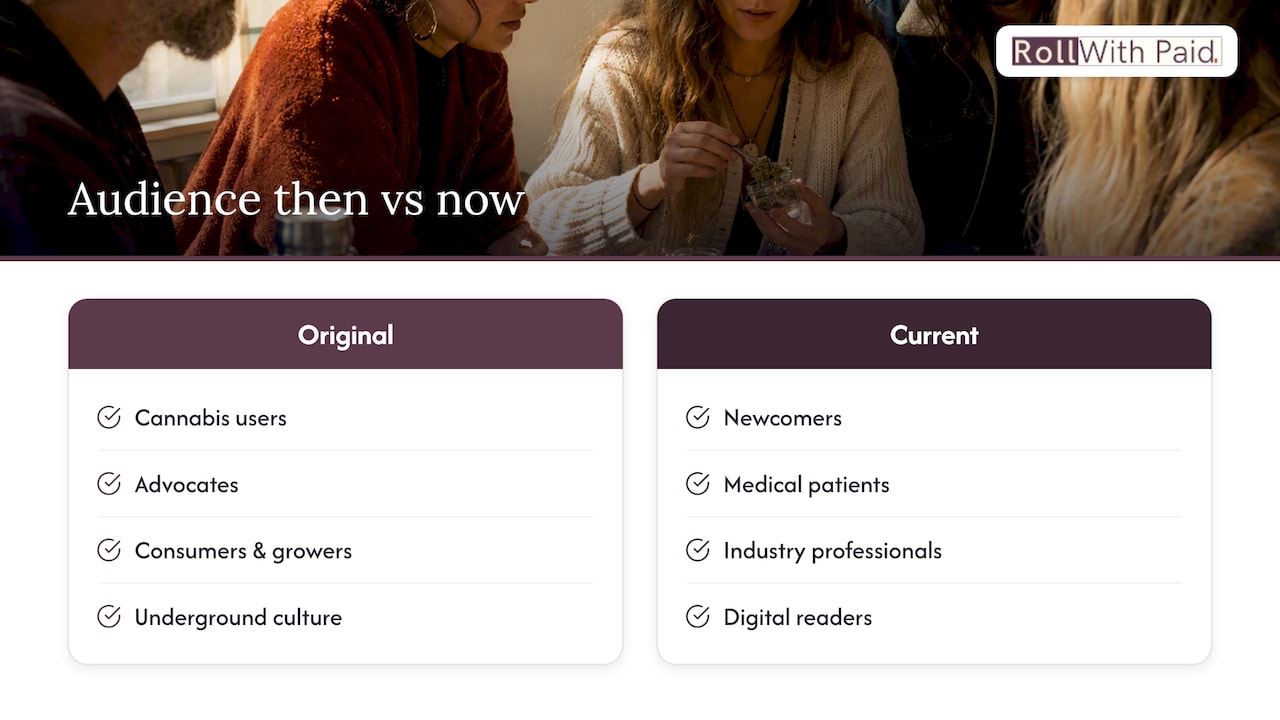
High Times built its original readership among cannabis users and advocates living under strict prohibition, a group that treated the magazine as both information source and cultural signal that they were not alone in their views. That audience skewed toward readers directly engaged in cannabis culture, whether as consumers, growers, or activists, rather than casual browsers.
As legalization expanded, the potential audience broadened considerably. Legal cannabis markets brought in curious newcomers, medical patients, and industry professionals who had no connection to the underground culture the magazine originally served, and that shift changed what readers expected from the content.
The relaunch appears to be recalibrating for a readership that values the brand’s history and collectible appeal as much as current reporting, which is part of why the quarterly print format leans into archival weight rather than trying to recapture mass newsstand circulation. Digital readers arriving through the daily-publishing website likely overlap only partially with the audience buying collectible print, suggesting the brand now serves two related but distinct audience segments rather than one unified readership.
How High Times Shaped Cannabis Marketing and Advertising
Before legal retail markets existed, High Times served as one of the only advertising channels available to cannabis-adjacent businesses, from paraphernalia makers to seed companies operating in a legal gray area. That early advertiser base shaped the visual and tonal conventions that later cannabis marketing would borrow: bold countercultural branding, irreverent copy, and imagery that openly celebrated cannabis use rather than euphemizing it.
As legal markets opened, dispensary brands and ancillary businesses adopted some of that same visual language, even as they operated under far stricter advertising rules than anything High Times ever faced. The magazine’s event brand, including its Cannabis Cup competitions, also became an early model for the kind of experiential marketing that cannabis companies now use at trade shows and brand activations.
The relaunch’s return to collectible print gives advertisers a different kind of value proposition than digital cannabis media typically offers: association with a historically significant, scarcity-driven product rather than high-volume impressions. That positioning echoes how the original magazine built advertiser loyalty, through cultural credibility rather than sheer reach.
What This Revival Means If You Work in Cannabis
Watching High Times come back from receivership reminds us that cultural authority in this industry is not automatically renewable just because a brand name survives. The relaunch team had to earn trust back by returning to the magazine’s original identity, not by assuming the name alone would carry it.
That matters for anyone working in cannabis, whether you are running a dispensary, growing product, or handling the business side of an operation. Trusted trade reporting helps you track where policy and culture are heading before those shifts show up in formal guidance, and a magazine with decades of archive material offers context that newer outlets simply do not have yet.
We would encourage you to read both the archival reporting and the new coverage coming out of the relaunch. The history explains why certain policy fights still matter, and the current reporting, including work from operator-contributors, shows how those fights are playing out in today’s legal and cultural landscape.
— Leah
FAQ
Do They Still Publish High Times Magazine?
Yes. High Times publishes a quarterly collectible print edition and updates its website daily since the 2025 relaunch under new ownership.
Where Can I Get High Times Magazine?
The current print editions are available through the official print subscription page, which also offers single-issue ordering. Back issues are generally found through specialist dealers or collector marketplaces rather than the subscription page itself.
What Is the High Times Subscription Cost?
High Times does not publish a universal subscription price in the sources available for this article, so readers should check the print subscription page directly for current pricing and issue details.
Are High Times Magazines Worth Money?
Early issues can carry collector value, but there is no standard appraisal market for them, so prices depend on condition, rarity, and private demand. Collectors typically assess value through specialist dealers or collector communities rather than a fixed price guide.
Sources
- High Times: The Drink in Your Hand Was Never Just a Drink
- High Times, Flying Once More (The New Yorker)
- High Times: A 40-Year History of the Magazine (New York Times)
Recommended
- Your Rights as a Cannabis Worker in Minnesota
- 280E and Payroll: What Cannabis Employers Need to Understand
- I-9 and E-Verify: A Compliance Guide for Cannabis Employers
Roll With Paid. is not a law firm and does not provide legal advice. This article summarizes Minnesota law as of August 2026 and is general information only. Tip arrangements are fact-specific; before changing a policy, consult employment counsel or contact DLI Labor Standards at 651-284-5075.