
Cannabis Workforce Training: What Minnesota Requires
In Minnesota, cannabis workforce training is a license condition, not a hiring perk. Every cannabis worker and volunteer must be trained every year on a set list of topics, and you must keep proof that each person completed it. This guide covers what the rule says, what Minnesota, New York and OSHA show about where training programs fail, and how to build a program that holds up when an inspector asks for your files.
TL;DR
- Minn. R. 9810.1102, subp. 2 requires annual, role-specific training on your SOPs, state and federal cannabis law, data privacy, security measures, emergency response and product recall.
- You must keep a record showing each worker completed it. Minn. R. 9810.1100, subp. 3 sets the retention period at three calendar years.
- Your application and every renewal must describe your employee training and education program, so the program has to exist before you apply.
- Shadowing a veteran employee is not documentation. Dated sign-offs, content outlines and role-based assignments are.
- Cultivation and extraction staff also need hazard-specific safety training (flammables, lockout/tag-out, respiratory exposure) that OSHA expects you to document.
Table of Contents
- Why Minnesota is setting the pace on cannabis workforce training
- What Minn. R. 9810.1102 actually requires
- Records: the part inspectors actually check
- Building the six annual modules
- What New York shows about auditing training
- Safety training beyond the six pillars
- Training is also a cost decision
- Common training failures we see
- A 30-day plan to get your program audit-ready
- Our perspective
- Where Roll With Paid fits
- FAQ
- Sources
Why Minnesota is setting the pace on cannabis workforce training
Most states treat training as an afterthought to licensing. Minnesota built it into the licensing rules. According to GreenState’s August 2026 reporting, the Office of Cannabis Management (OCM) had issued 303 full licenses and roughly 1,405 preliminary approvals, and 43% of licenses went to social equity applicants. The same report notes that the state funds organizations preparing this workforce through the Department of Employment and Economic Development’s CanTrain program and OCM’s CanGrow program.
The logic is practical. Many Minnesota operators are new, small and thinly capitalized. A trained team on day one means fewer compliance errors, less turnover and fewer expensive corrections later. GreenState quotes cannabis attorney Yvette McDowell describing training as survival infrastructure for small and social equity operators who cannot absorb the cost of turnover or penalties.
The rule behind that approach is short, and every owner should read it in full.
What Minn. R. 9810.1102 actually requires
The training rule sits in Minn. R. 9810.1102, “Cannabis and Hemp Workers.” Subpart 2 applies to cannabis workers and cannabis volunteers. It does not apply to hemp workers who fall outside the statutory definition of a cannabis worker. Four obligations matter most.
- Annual training. On top of any workplace training required by federal, state or local law, you must ensure each worker or volunteer receives annual training that applies to the role, authority and responsibilities of that person.
- Six required topics. The annual training covers your standard operating procedures, state and federal cannabis law, data privacy, security measures, emergency response, and product recall.
- Records. You must keep records on each worker who conducts activities authorized by OCM, including proof the worker completed the required training, and make them available to OCM on request.
- Program description. Your license application and each renewal must describe your employee training and education program.
The rule also requires an edible cannabinoid product handler’s endorsement for anyone covered by Minnesota Statutes, section 342.07, subdivision 3. If your team handles edibles, add that to the onboarding checklist.
Two details are easy to miss. First, “cannabis volunteer” is a defined term in the Chapter 9810 rules: it covers anyone whose scope of work matches a cannabis worker’s but who is not paid. Unpaid helpers at an event or a harvest are not exempt from training. Second, the training must fit the role. A single generic slide deck for everyone is a weak answer when a trimmer and a store manager have very different authority and responsibilities.
Records: the part inspectors actually check
Training that happened but cannot be proven did not happen, as far as an inspection is concerned. Minn. R. 9810.1100, subp. 3 keeps these records for three calendar years. Keep in mind that this is calendar years, so a record created in March 2026 should not leave your files before the end of 2029.
The state’s rule text says records must be available to OCM on request. In practice, expect to produce them quickly, so a shared drive with inconsistent file names will not do. A defensible training file for each worker contains:
- Name, role, hire date and the date of each training session
- The topics covered, mapped to the six required pillars
- The version of the SOPs or policy the worker was trained on
- The trainer’s name or the course provider
- A signed or electronically acknowledged completion record
- Any role-specific certificates, such as the edible handler’s endorsement
A simple matrix helps. Put workers in rows, the six pillars in columns, and the completion date in each cell. Gaps become visible at a glance, and an inspector sees the same thing you do.
Building the six annual modules
The rule names the topics but leaves the design to you. Here is how we would structure each one so it is specific to your site and easy to document.
| Required topic | What to cover | What to keep on file |
|---|---|---|
| Standard operating procedures | The SOPs for the worker’s own role: receiving, inventory, sales, cultivation, processing | SOP version number, acknowledgment |
| State and federal cannabis law | License conditions, age and purchase limits, what federal law still prohibits (banking, interstate transport) | Slide deck or outline, completion date |
| Data privacy | Customer ID handling, patient or purchaser records, employee data, who may access what | Policy acknowledgment, access list |
| Security measures | Access control, cameras, cash handling, visitor rules, workplace violence response | Drill or session log |
| Emergency response | Fire, injury, robbery, power loss, evacuation, who calls whom | Drill record, posted plan |
| Product recall | Lot tracing, stop-sale steps, quarantine, notification | Tabletop exercise record |
For the security module, a practical outside reference is this workplace violence prevention plan for employers, which is useful when you are deciding how to frame response drills for staff.
Make it role-specific without making it unmanageable
Start with one core session that every worker takes, then add short role modules. A budtender needs deeper coverage of ID checks and purchase limits. A cultivation technician needs deeper coverage of pesticide handling and lockout/tag-out. A manager needs the recall and data privacy modules in full. Document the core and the role add-ons separately so the file shows both.
Time it to your calendar
The rule says annual, so pick a rhythm you can defend. Many operators run the full refresher in one month each year, then train new hires within their first days and again at the next cycle. Whichever you choose, write it into your training program description, because that description is part of your license file.
What New York shows about auditing training
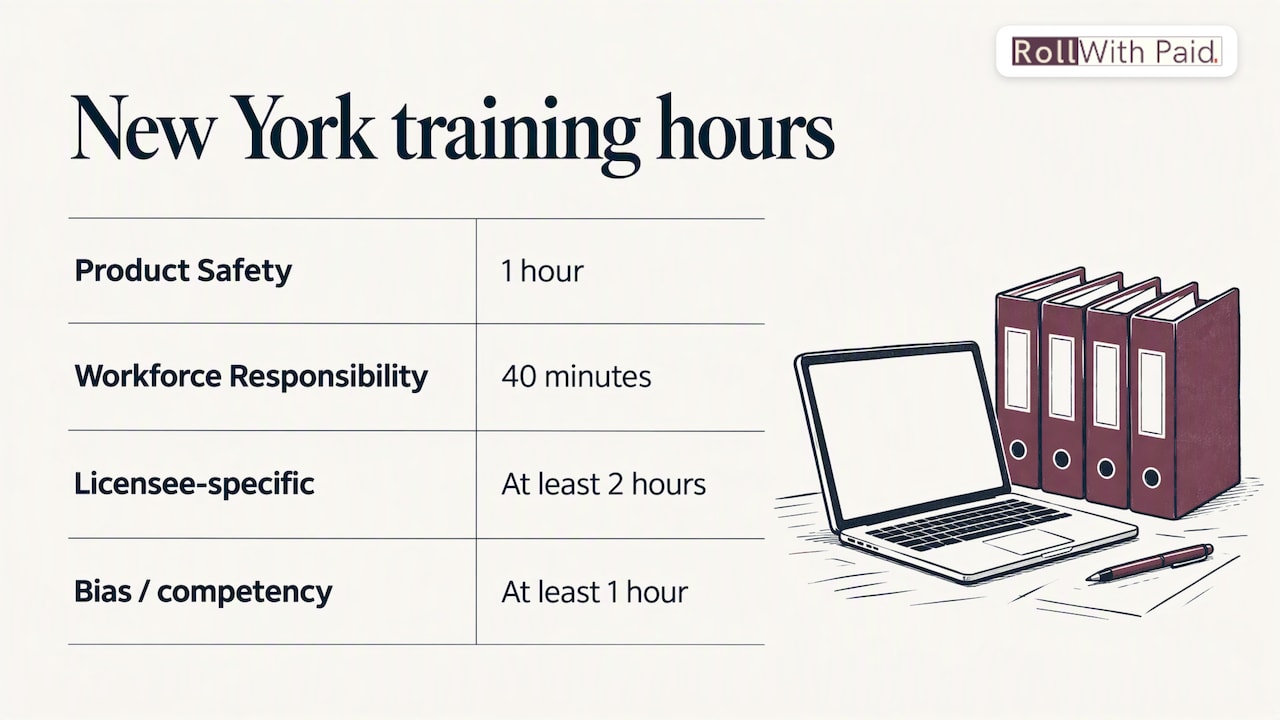
Minnesota’s rule is less prescriptive than some other states, and that cuts both ways. You have design freedom, but you also own the burden of showing the content was adequate. New York offers a useful contrast. Its Responsible Workforce Training requires everyone working under a licensed cannabis business to complete four components within 30 days of their start date: a 1-hour Cannabis Product Safety course, a 40-minute Cannabis Workforce Responsibility course, at least 2 hours of licensee-specific training, and at least 1 hour of implicit bias or cultural competency training. The state supplies the two core courses free online, and licensees must develop and document the rest.
That structure shows what regulators tend to look for: specific hours, specific topics and a paper trail. Minnesota does not copy New York’s hour counts, so do not cite them as Minnesota law. But if you operate in both states, or want a benchmark for how much time a serious program takes, the New York model is a reasonable yardstick. For multi-state operators, our guide to audit-ready multi-state cannabis payroll covers how to keep state-by-state obligations from colliding.
Safety training beyond the six pillars
The six topics in the state rule do not replace workplace safety obligations. The rule itself says training applies in addition to training required by federal, state and local law, and 9810.1102 separately requires compliance with worker safety and health provisions under Minnesota Statutes chapter 182 and the related Minnesota rules.
The gap is real across the industry. In its Local Emphasis Program for cannabis industries, OSHA’s materials point to Colorado survey data in which 23% of cannabis workers reported never receiving safety training and only 15% received continuous, structured training. Serious injuries in this sector include burns from extraction and chemical exposure.
If you cultivate or process, build these into your program and document each one:
- Hazard communication for fertilizers, pesticides, cleaning agents and solvents
- Flammable liquids handling for any concentrate work
- Lockout/tag-out for trimmers, extractors and other industrial equipment
- PPE selection, fit and use
- Respiratory exposure: OSHA’s publication on occupational allergies and asthma in cannabis cultivation and production explains why workers who develop symptoms should tell their employer and healthcare provider promptly and why reducing exposure early matters
Some states offer voluntary recognition for employers who go further. Nevada’s first cannabis SHARP designee, Acres Cultivation, is an example. Minnesota operators can treat that kind of program as a benchmark for what rigorous documentation looks like, whatever route they choose.
A worker who is injured or reports a hazard should also know their protections. Our explainer on your rights as a cannabis worker in Minnesota is worth handing out in orientation.
Training is also a cost decision
It is tempting to see training hours as pure expense. The opposite is usually true in a young, thin-margin industry. GreenState’s reporting notes that operators who prioritize early training in seed-to-sale compliance and state law reduce the turnover costs that plague the industry. If you want to understand how turnover erodes a budget, this white paper on the toll of turnover lays out the framing, though it comes from another sector.
There is a career side as well. GreenState describes cannabis as one of the few industries where an entry-level worker can plausibly reach management within a few years, because the market is young. Workers who see a path tend to stay, and a documented training program is the first rung of that path. Sativa University’s career overview puts budtender pay at roughly $17 to $26 per hour and store manager pay at $65,000 to $110,000, which gives you a sense of what the ladder is worth to your people. Treat those as national estimates, not Minnesota wage data.
Common training failures we see
These patterns turn a compliant operator into a citation:
- Training happens, records do not. The session was real, but the sign-in sheet is missing.
- One-time onboarding only. The rule says annual. A great orientation in 2025 does not cover 2026.
- Shadowing counts as training. Pairing a new hire with a veteran is useful, but it is not documented instruction on the six topics.
- SOPs changed, training did not. If you revise a recall procedure in June, retrain affected staff and record the new version.
- Volunteers and part-timers skipped. The rule reaches volunteers, and seasonal workers are workers.
- Records stored by one person. When that manager leaves, so do the files.
Training is also tied to hiring paperwork. Make sure onboarding includes proper employment eligibility verification, and see our I-9 and E-Verify guide for cannabis employers. New hires also trigger a state filing; the Minnesota new hire reporting checklist walks through it.
A 30-day plan to get your program audit-ready
Week 1: Inventory. List every worker and volunteer, their role and their last documented training. Pull your current SOPs and note version dates.
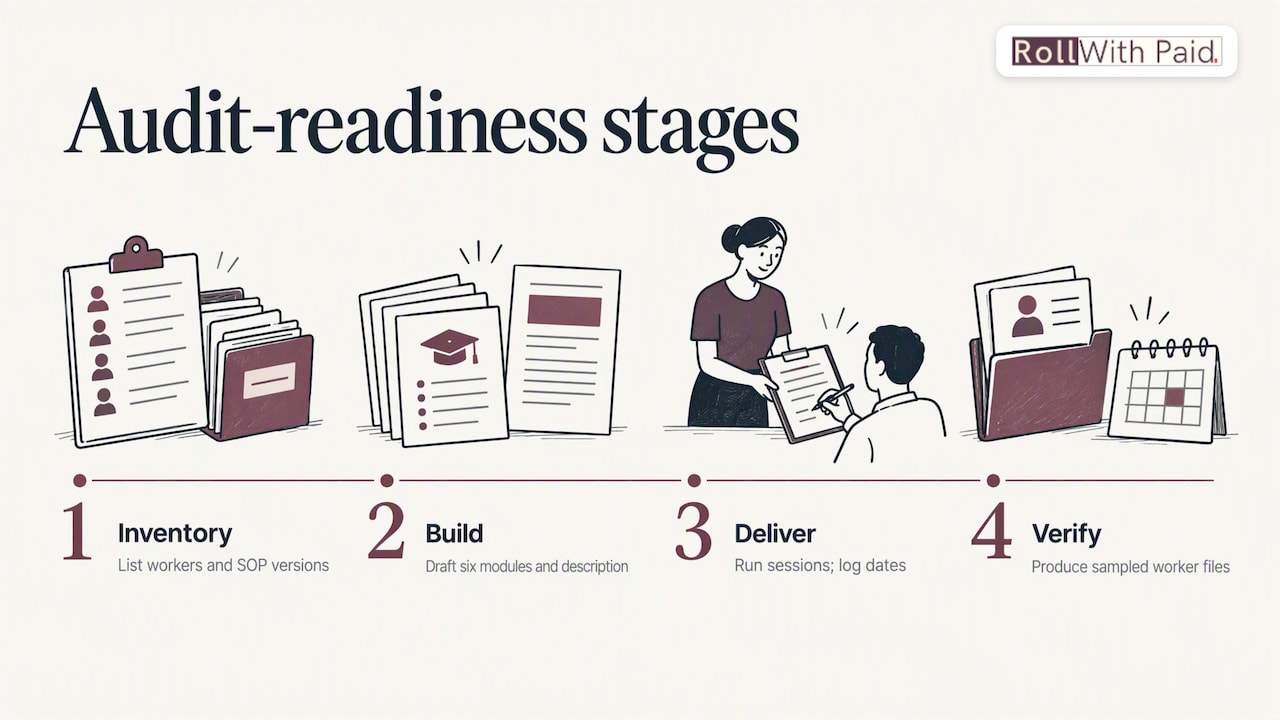
Week 2: Build. Draft the six modules and role add-ons. Write the one-page program description your license application and renewal require.
Week 3: Deliver. Run sessions, collect acknowledgments the same day, and log dates in the matrix.
Week 4: Verify. Pick three workers at random and try to produce their full training file in minutes. Fix whatever slows you down. Set calendar reminders for next year’s cycle and for the end of each record’s three-calendar-year retention window.
Our perspective
We work with dispensaries, cultivators and other high-risk employers every day, and the pattern is consistent: operators rarely fail because they refuse to train. They fail because training, payroll and HR records live in different places and nobody owns the whole picture. A worker’s hire date, classification, onboarding documents and training completions are one story, and an inspector will read them as one story.
That is why we treat training documentation as part of HR compliance, not a side project. When your onboarding, policies and records are organized from the first day, an annual refresher becomes a routine task rather than a quarterly fire drill. The same discipline protects you on classification, workers’ compensation and filings, because a business that can show what it taught and when is usually a business that can show everything else too.
Our advice is simple. Write the program down, assign an owner, train every year, and store the proof where more than one person can find it. Organizations such as the Minnesota Cannabis College offer affordable training programs that are designed with curriculum that covers the annual requirements. Bringing in an outside party to administer the training reduces the impact on your staff, and is a much easier solution than developing and implementing this yourself. Learn more about Cannabis workforce training requirements on the MNCC newsletter.
— Leah Kollross
Where Roll With Paid fits
Training records are only one piece of the paperwork cannabis employers carry. Roll With Paid. provides payroll execution, HR and compliance solutions, onboarding and Employer of Record services built for cannabis and other high-risk industries, so your onboarding, policies and worker files stay organized and audit-ready in one place. If you want help structuring that for a Minnesota operation, start with our HR and compliance services or see how service rates and the HR retainer work.
FAQ
Is cannabis workforce training required in Minnesota?
Yes. Minn. R. 9810.1102, subp. 2 requires license holders to provide annual, role-specific training to cannabis workers and volunteers. It must cover SOPs, state and federal cannabis law, data privacy, security measures, emergency response and product recall.
How long do I keep training records?
Three calendar years under Minn. R. 9810.1100, subp. 3. The records must show that each worker completed the required training and must be available to OCM on request.
Do I need a certification to work at a dispensary?
Requirements differ by state. In Minnesota, the rule puts the training duty on the license holder, and an edible cannabinoid product handler’s endorsement applies where Minnesota Statutes, section 342.07, subdivision 3 covers the worker. Confirm the current rules with OCM before hiring.
Does the training rule apply to unpaid volunteers?
Yes. Subpart 2 applies to cannabis workers and cannabis volunteers, and the rules define a volunteer as someone doing a cannabis worker’s scope of work without compensation. Train and document them like staff.
Is on-the-job shadowing enough?
No. Shadowing helps people learn, but it does not show that you covered the six required topics. Keep dated, topic-specific records for each worker.
This article is general information, not legal advice. For questions about your license conditions, contact OCM or a cannabis attorney licensed in Minnesota.
Sources
- Minn. R. 9810.1102, Cannabis and Hemp Workers
- Minn. R. 9810.1100
- Minn. R. chapter 9810
- GreenState: Cannabis has a workforce problem. Minnesota may have the answer
- Train them annually, and keep the records: Minnesota’s worker-training rule, plainly
- New York OCM: Responsible Workforce Training
- OSHA CPL 24-04 (EP): Local Emphasis Program for Cannabis Industries
- OSHA: Occupational Allergies and Asthma in the Cannabis Industry
- OSHA: Acres Cultivation SHARP success story
- Sativa University: Cannabis careers
Recommended
- Your Rights as a Cannabis Worker in Minnesota
- 6 Contract Must Haves for Minnesota Cannabis Background Checks
- I-9 and E-Verify: A Compliance Guide for Cannabis Employers
Roll With Paid. is not a law firm and does not provide legal advice. This article summarizes Minnesota law as of August 2026 and is general information only. Tip arrangements are fact-specific; before changing a policy, consult employment counsel or contact DLI Labor Standards at 651-284-5075.