
6 Contract Must Haves for Minnesota Cannabis Background Checks

Choose a background check company that is accredited by the Professional Background Screening Association, certifies FCRA compliance in writing, and can submit results directly to the licensing division rather than only to you. Before signing anything, ask the vendor to confirm, in writing, that they will send results to the licensing division and that they can provide standard FCRA notices. That one confirmation prevents most of the rejected applications and compliance headaches that follow.
TL;DR:
- Use PBSA-accredited vendors attested by the Minnesota Office of Cannabis Management that can submit results directly to the licensing division to avoid application rejections.
- Confirm in writing that your background check provider will send results to the licensing division and can produce FCRA-compliant notices before signing any contract.
- Ensure the vendor handles fingerprinting and FBI checks, provides a sample report, and agrees to specific turnaround times and dispute resolution processes in the contract.
- Conduct a pilot check with a few staff members and request references from previous cannabis license applicants to verify vendor reliability and industry experience.
- Follow FCRA rules strictly by providing clients with clear disclosures, waiting for signed authorizations, and giving final notices before adverse decisions, especially during licensing submissions.
Table of Contents
- Which background check companies meet cannabis licensing standards?
- What to demand in a background check vendor contract
- How to run a compliant background check from start to finish
- What an integrated compliance approach adds to background screening
- How Roll With Paid supports your hiring and compliance workload
- Where to verify the rules yourself
- Sources
- FAQ
Which background check companies meet cannabis licensing standards?
Minnesota’s Office of Cannabis Management requires qualified applicants to use third-party consumer reporting agencies that comply with the FCRA and hold PBSA accreditation, and the agency publishes a list of vendors that have attested to meeting those requirements. That attestation matters more than a vendor’s marketing copy: it is the closest thing to an official seal of approval in this space.
OCM-attested vendors appear directly on the agency’s resource list and have attested to PBSA accreditation and FCRA compliance:
- 3rd Degree Screening, Inc. lists services specifically for Office of Cannabis Management applicant checks, making it a straightforward starting point for license applicants who want a vendor already familiar with the submission process.
- Creative Services, Inc. maintains a Minnesota-specific product page for OCM submissions, which suggests some operational experience with the state’s exact reporting format.
- Global Investigative Services, Inc. runs a dedicated Minnesota OCM page and routes contact requests for cannabis applicants, useful if you want a vendor that has already built a workflow around the state’s requirements.
- TruDiligence, through its branded MyTruSeal product, offers a packaged submission workflow built around Minnesota OCM requirements, which can simplify the paperwork for a first-time applicant.
- Veritable Screening and Private Eyes Screening Group both appear among the attested vendors, with Private Eyes positioned as a smaller regional option for operators who want a vendor with direct cannabis licensing experience but a lighter footprint than the national firms.
Vendors with broader national reach are worth considering when you need coverage beyond Minnesota, or when you are screening owners or key personnel with out-of-state history:
- Accurate Information Systems advertises national and international coverage, which fits multi-jurisdictional criminal record searches for applicants with residency history in more than one state.
- FirstPoint Background Screening Resources, Inc. offers packaged national criminal search products aimed at ownership and key-person screening, a common need when a cannabis license application lists multiple true parties of interest.
- True Hire leans toward enterprise clients and multi-location operators, which suits a business planning to open several licensed sites rather than a single dispensary.
- EagleScreen provides direct vendor contact channels for licensing customers, a practical detail when you need quick answers about turnaround or documentation.
- Sapphire Background Check publishes a product page aimed specifically at cannabis companies, which signals some awareness of the industry’s documentation needs even without explicit Minnesota OCM listing.
Whichever vendor you consider, ask the same three questions: do they hold PBSA accreditation, will they submit results directly to the licensing division, and can they produce a sample report showing how they handle fingerprint and FBI check data. A vendor that hesitates on any of the three is a vendor to keep shopping past.
What to demand in a background check vendor contract
Before you sign a services agreement with any screening company, confirm the following items in writing. This isn’t paperwork for its own sake: a missing attestation or a vague delivery promise is exactly the kind of gap that gets an application bounced back by the licensing division.
- PBSA accreditation or equivalent certification, documented and current, not just referenced in sales materials.
- Written FCRA-compliant disclosure and consent templates that you can hand to applicants without drafting your own from scratch.
- A clear commitment to submit results directly to the licensing division, not just to you, along with a written attestation confirming they did so.
- Multistate criminal-locator coverage if any owner, manager, or key person has lived or worked in more than one state.
- Fingerprint and FBI check handling, since Minnesota’s licensing process requires both state and federal criminal history, not just a database search.
- A sample report showing exactly which fields the vendor returns, so you know what you and the licensing division will actually see.
On the contract side, get the vendor to commit to a turnaround time in writing, a documented dispute-resolution process for applicants who challenge a finding, and inclusion of the federal “Notice to Users of Consumer Reports” and “A Summary of Your Rights Under the FCRA” with every report they deliver.
Watch for a few red flags during procurement: a vendor that won’t put FCRA compliance in writing, one that describes licensing submission in vague terms (“we can help with that”) rather than a specific process, or one with no stated record-retention policy. Any of those should push you toward a different vendor, regardless of price.
Pro Tip: Run a pilot background check on one or two staff before committing to a full contract, and ask the vendor for references from other cannabis license applicants who have already gone through the process.
How to run a compliant background check from start to finish
The sequence differs slightly depending on whether you are screening a job applicant or submitting checks for a license application, but both follow the same basic FCRA skeleton.
For hiring staff:
- Wait until after the interview, ideally at the conditional offer stage, before asking about criminal history, consistent with Minnesota’s ban-the-box approach.
- Provide a standalone written disclosure and get signed authorization before ordering any report, as the FTC requires of any employer using consumer reports for employment decisions.
- Order the report from your accredited vendor and review results against a job-related, business-necessity standard rather than a blanket exclusion policy, per EEOC guidance.
- If the report may lead to a negative decision, send a pre-adverse action notice with a copy of the report and the FCRA summary of rights.
- Give the applicant reasonable time to respond, then send a final adverse action notice if you proceed with the decision.
For a license application, the sequence adds a submission step: complete fingerprint collection for every true party of interest, have your vendor run the state and FBI checks, and confirm the vendor submits results directly to the licensing division rather than routing them through you first. Keep the vendor’s attestation of submission and a copy of everything sent, since that documentation is what protects you if a submission is questioned later.
Disputes over sealed or expunged records, or requests for a retest, should go through the vendor’s documented process, not an informal phone call. Keep a written record of every step.
What an integrated compliance approach adds to background screening
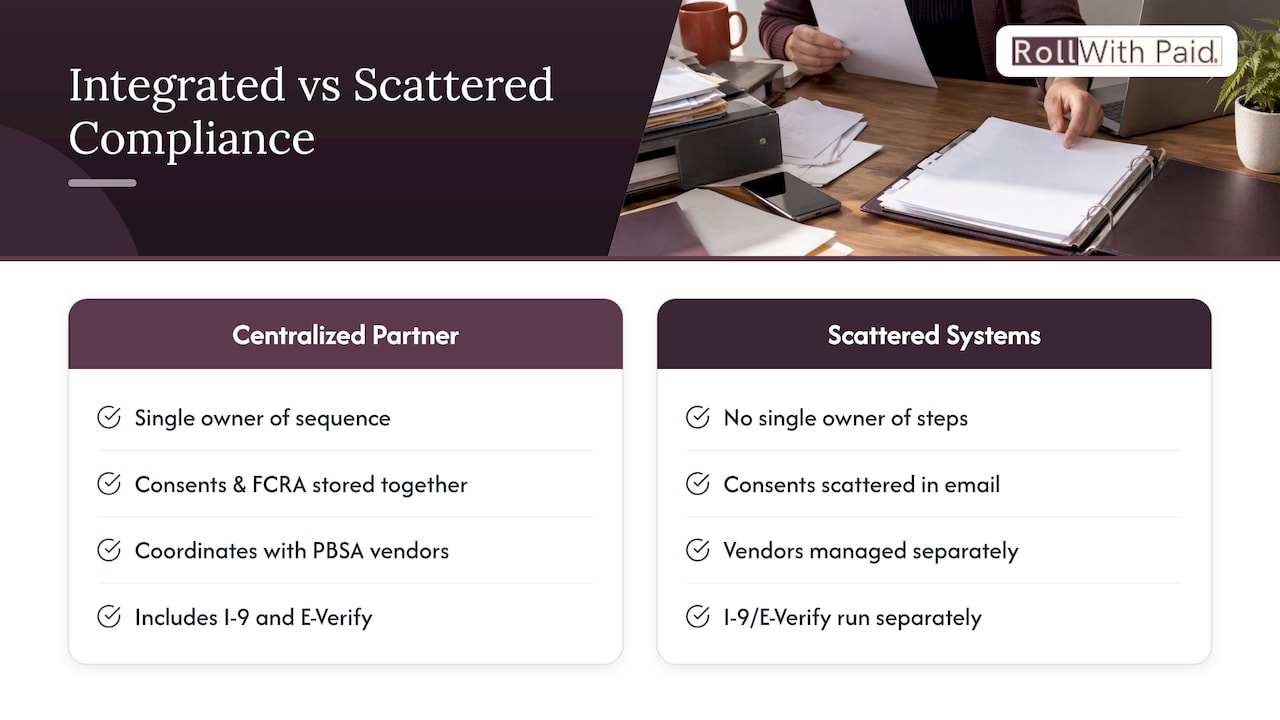
Coordinating consents, FCRA notices, and licensing attestations across separate systems is where a lot of cannabis operators lose track of paperwork, not because the individual steps are hard, but because nobody owns the whole sequence. A managed HR and payroll partner that centralizes those documents removes the guesswork of who has the signed disclosure, who confirmed the vendor’s submission, and who is holding the adverse action timeline.
Roll With Paid supports cannabis operators by coordinating with PBSA-accredited screening vendors rather than replacing them, and by keeping consent forms, FCRA documentation, and license-submission attestations in one place instead of scattered across email threads. The same coordination extends to I-9 and E-Verify processes, which run alongside background checks during onboarding for most cannabis employers.
Compliance paperwork for a cannabis license applicant is rarely one document. It’s a chain of attestations, and the chain breaks at whichever link nobody was watching.
— Leah
How Roll With Paid supports your hiring and compliance workload
Vetting background check vendors, tracking FCRA notices, and managing onboarding paperwork is a lot to run alongside actually operating a dispensary or cultivation facility. Some managed HR and payroll partners work with cannabis operators to handle payroll execution, HR and compliance support, and employee onboarding to reduce administrative burdens.

This coordination can include working with accredited background-check vendors without replacing them, focusing on documentation, onboarding, and multi-state hiring processes around the existing background checks. That includes:
- Employer of Record services that handle payroll, tax filings, and compliance administration under one agreement.
- HR retainer support for policy documentation, recordkeeping, and audit-ready files.
- Seamless employee onboarding, including I-9 and E-Verify coordination alongside your screening vendor’s timeline.
- Multi-state hiring support for operators managing licenses or staff across more than one jurisdiction.
If you want to see how this fits your operation, check our pricing page or visit Rollwithpaid to schedule a compliance intake.
Where to verify the rules yourself
- Minnesota OCM’s license applicant background check resources, including the attested vendor list.
- Minn. Stat. 181.951 on drug and alcohol testing limits.
- FTC guidance for employers using consumer reports.
- EEOC guidance on criminal history screening.
- For hiring policy language, see Ban the Box: Expungement Minnesota and this legal guide to high-risk terminations.
This article is general information, not a substitute for advice from a qualified lawyer. Consult a qualified legal professional about your own circumstances before acting on anything here.
Sources
- Background Check Resources for License Applicants — Minnesota OCM
- Using consumer reports: What employers need to know — FTC
- Minn. Stat. 181.951: Drug and alcohol testing (Minnesota statutes)
- EEOC enforcement guidance on arrest and conviction records
FAQ
What company do most employers use for background checks?
There is no single dominant vendor across all industries, and for Minnesota cannabis license applicants specifically, the choice narrows to vendors attested on the OCM’s vendor resource list. Employers generally pick based on PBSA accreditation, FCRA compliance documentation, and whether the vendor can submit results directly to the licensing division.
What are the top cannabis background check companies?
Vendors commonly used for Minnesota cannabis licensing include 3rd Degree Screening, Accurate Information Systems, Creative Services, EagleScreen, FirstPoint Background Screening Resources, Global Investigative Services, TruDiligence, True Hire, Veritable Screening, Sapphire Background Check, and Private Eyes Screening Group. Several of these appear on the OCM’s attested vendor list, which is the most reliable starting point for verification.
What do dispensary background checks look for?
A dispensary background check typically covers state and federal criminal history, verified through fingerprints and an FBI check, along with identity confirmation for the applicant. Minnesota’s licensing process also requires checks on every true party of interest listed in a license application, not just the primary applicant.
Can a company still hire you if you fail a drug test?
In Minnesota, employers generally cannot refuse to hire someone solely for a positive cannabis test unless the role is safety-sensitive or another statutory exception applies, under Minn. Stat. 181.951. Background checks and drug testing are separate processes with different rules, so a criminal-history result and a drug test result should never be evaluated under the same policy.
Recommended
- Your Rights as a Cannabis Worker in Minnesota
- Ban the Box: Expungement Minnesota
- I-9 and E-Verify: A Compliance Guide for Cannabis Employers
- 5 Payroll Mistakes Cannabis Businesses Can’t Afford
Roll With Paid. is not a law firm and does not provide legal advice. This article summarizes Minnesota law as of August 2026 and is general information only. Tip arrangements are fact-specific; before changing a policy, consult employment counsel or contact DLI Labor Standards at 651-284-5075.