
Best Labor Law Posters for 2026: Free vs. Paid Options
The best labor law posters are the ones issued by the government agencies that enforce the law, because they are free, current and legally authoritative. A paid all-in-one service is worth buying only if it saves you time and keeps you from missing a replacement. A poster set does not make you compliant on its own, and that matters most if you run a cannabis business. Below we compare your real options, show what Minnesota employers must post, and explain where posters stop and compliance begins.
TL;DR
- The U.S. Department of Labor provides its required federal posters free of charge, and Minnesota’s Department of Labor and Industry (DLI) does the same for state posters.
- Paid all-in-one kits and subscription services are a convenience, not a legal requirement. The value is in automatic replacements and multi-location coverage.
- Cannabis employers need more than posters: state safety notices, a posted drug and cannabis testing policy notice in Minnesota, and the safety records that posters only point to.
- Posters are one line item on an audit checklist. Wage notices, I-9s, safety programs and payroll filings carry more risk.
Table of Contents
- What “best” means for labor law posters
- Your four real options
- Option 1: Free government posters
- Option 2: One-time all-in-one poster kits
- Option 3: Poster subscription services
- Option 4: Let your payroll and HR partner own it
- What Minnesota employers need to post
- Cannabis employers: where generic posters fall short
- Remote and hybrid staff
- A quick poster audit you can do in an afternoon
- Perspective: posters are the easy part
- When it makes sense to bring in a partner
- FAQ
- Sources
What “best” means for labor law posters
Search results for this topic are crowded with vendors who each claim to be the best. Most of them sell the same thing: laminated federal and state notices bundled together. So the useful question is not which vendor is best. It is which of four approaches fits how you operate.
Judge any option on five criteria:
- Accuracy. Does it include every federal, state and local notice that applies to your worksite, in the current version?
- Currency. Who tells you when a poster changes, and how fast does a replacement arrive?
- Coverage. Does it handle multiple locations, other languages and remote employees?
- Cost. What do you pay once, and what do you pay every year?
- Fit for your industry. Does it account for sector-specific rules, such as cannabis safety notices?
Your four real options
| Option | Typical cost | Best for | Main weakness |
|---|---|---|---|
| Free agency downloads (DOL, EEOC, OSHA, state agency) | Free plus printing | Single-location employers willing to check updates | You track every change yourself |
| One-time all-in-one poster kit | Varies by seller | Small employers who want one laminated set | Often misses local or industry notices |
| Poster subscription service | Recurring fee | Multi-location employers with no HR staff | You pay for something agencies give away |
| Payroll and HR partner that manages notices | Included in a broader service | Regulated, high-risk employers | Only makes sense if you need the rest of the service |
None of these is wrong. The mistake is paying for a poster service and assuming the job is finished.
Option 1: Free government posters
This is the baseline every other option gets measured against. The DOL states that it provides free electronic copies of the required posters, and its FirstStep Poster Advisor helps you work out which federal DOL posters apply to your business. The DOL’s posters FAQ also covers whether a combined “six-in-one” poster can replace separate ones. In short, it can, provided every poster you are required to display is actually in it.
The core federal notices most workplaces display are:
- Fair Labor Standards Act (FLSA): minimum wage and overtime.
- Family and Medical Leave Act (FMLA): for covered employers.
- Employee Polygraph Protection Act (EPPA).
- OSHA “Job Safety and Health: It’s the Law”: under 29 CFR 1903.2, employers must post the notice furnished by OSHA.
- EEOC “Know Your Rights: Workplace Discrimination is Illegal”: the EEOC poster page says the law requires employers to post it, and the revised version is dated June 27, 2023, to reflect the Pregnant Workers Fairness Act.
If you still display the older “EEO is the Law” notice, replace it. The EEOC released the updated poster in October 2022, and its FAQ on the revised poster explains the changes.
Strengths: no cost, always the authoritative version, and no sales pitch.
Weaknesses: you have to know which posters apply, check for updates, and print and laminate them yourself.
Option 2: One-time all-in-one poster kits
These are the products that dominate the search results: a single laminated sheet or set that combines federal and state notices for your state. Several long-established sellers, including J. J. Keller, Poster Guard and Labor Law Center, offer versions of this. Prices and guarantees differ by seller, so read the current terms on each seller’s own site.
The appeal is real. You order once, hang it, and you are done for the year. For a one-room office with no unusual obligations, that can be a perfectly reasonable use of a small budget.
The risk is the word “all.” The DOL’s FAQ on combined posters makes clear that a combination poster only works if it covers every poster you are required to display. Federal notices change, and states add and revise their own. A kit printed months ago can be out of date by the time it reaches your wall.
Option 3: Poster subscription services
A subscription adds one feature to the kit: the vendor monitors law changes and sends replacements when a notice is revised. That is the part worth paying for, particularly if you have several locations in different states and nobody whose job it is to watch for updates.
Before you sign, ask three questions:
- Does the service cover local (city and county) notices, or only federal and state?
- Does it cover industry-specific notices, such as safety posters for cultivation or manufacturing?
- Is a replacement sent automatically, or do you need to request it?
If the answers are vague, you are paying a recurring fee for a product you can download free.
Option 4: Let your payroll and HR partner own it
For regulated businesses, posters are best handled inside a broader compliance process rather than bought as a standalone product. A partner that already knows your states, headcount and worker classifications can confirm which notices apply, flag when they change, and check them against the rest of your obligations.
That is the model we use at Roll With Paid. We work with cannabis and other high-risk employers, and notices are one piece of an audit-ready file, not a separate errand. More on that below.
What Minnesota employers need to post
Minnesota readers search for state labor law posters more than any other variation of this topic, so here is the state picture. Check the DLI page for current details before you print anything.
According to the DLI’s workplace posters page, Minnesota law requires employers to display certain posters where employees can easily see them. The posters are available at no cost, and you can download a free pack, order online, or email a request to the DLI. The same page lists a minimum-wage poster for 2027 that all employers must display, last updated in October 2026. It also lists an earned sick and safe time poster as informational only, meaning encouraged rather than required.
Because the DLI says posters are updated when Minnesota law changes, sign up for its update notifications instead of paying someone else to watch for you.
The wage theft notice is not a poster
Many Minnesotans search for a “wage theft notice” expecting a wall poster. It is different. Under the Minnesota Wage Theft Prevention Act, every employer must give each employee a written notice at the start of employment and keep a signed copy on file. The DLI’s wage theft Q&A also explains that changes to the notice must be provided in English and in the language the employee requests, and that the wage notice and the earnings statement have different required contents.
This is the classic case of two things wearing one name. A poster on the wall does not satisfy a document that has to be handed to a person, signed and filed. We break down the full obligations in our guide to the Minnesota Wage Theft Prevention Act.
Other Minnesota items to line up
Paid leave and new-hire reporting come with their own notices and deadlines. Our guides to Minnesota paid leave employer obligations and the Minnesota new hire reporting checklist cover what sits alongside the posters.
Cannabis employers: where generic posters fall short
Cannabis is still federally illegal while regulated by states, and safety and employment requirements vary widely from state to state. A generic multi-state poster is built for the average workplace, and a dispensary or grow is not average.
Three gaps come up repeatedly.
1. State safety notices. Federal OSHA requires its poster, but in states that run their own OSHA-approved plans, employers are generally expected to post state-specific safety information. OSHA’s regulation on posting notices is the starting point, and your state agency is the authority on which version applies.
2. Minnesota’s testing policy notice. Minnesota’s drug and alcohol and cannabis testing statute, section 181.952, requires an employer that adopts such a policy to give employees written notice and to post notice in an appropriate, conspicuous location that the policy exists and is available for inspection. That is an obligation no off-the-shelf kit can fulfill for you, because it depends on your own policy.
3. Records a poster can’t replace. OSHA has addressed the point directly: in a 2018 interpretation letter it considered whether posting the federal poster satisfies the employee-notification duties under its exposure and medical records standard. Cultivation and extraction also raise hazards such as respiratory risks. OSHA’s publication on allergies and asthma in cannabis cultivation recommends a multifaceted approach including medical screening and surveillance. A laminated sheet does none of that.
For more on the wider checklist, see our HR compliance tips for dispensaries and cultivations.
Remote and hybrid staff
A breakroom poster only reaches people who walk into the breakroom. The EEOC’s guidance on its poster encourages digital posting where employees don’t regularly come to a physical site, and a link buried on an HR page may not look conspicuous to an auditor. If part of your team is remote, put the notices on the intranet or portal staff use daily, and keep the physical set at every worksite.
A quick poster audit you can do in an afternoon
- List every worksite by address, including grow rooms, processing areas and satellite locations.
- Run the DOL’s FirstStep Poster Advisor for federal DOL posters.
- Confirm the EEOC poster is the June 27, 2023 version or later, and that the OSHA poster is current.
- Download your state posters from the state agency. In Minnesota, that means the DLI pack and the 2027 minimum-wage poster.
- Check city and county requirements with the local government.
- Post notices where employees can easily see them, and digitally for remote staff.
- Add a dated note to your compliance file recording what you posted and when.
- Set a calendar reminder to review in January and again after any legislative session.
The EEOC poster carries a monetary penalty for failure to display it, which the agency’s page notes is adjusted for inflation. Confirm the current amount on the EEOC poster page before you cite a figure to anyone.
Perspective: posters are the easy part
We talk with cannabis owners every week who have a perfectly laminated poster set and a stack of real exposure behind it. The problem is rarely the wall. It is the wage notice that was never signed, the employee classified under the wrong workers’ compensation code, the I-9 that was never completed, or the quarterly filing that went in late.
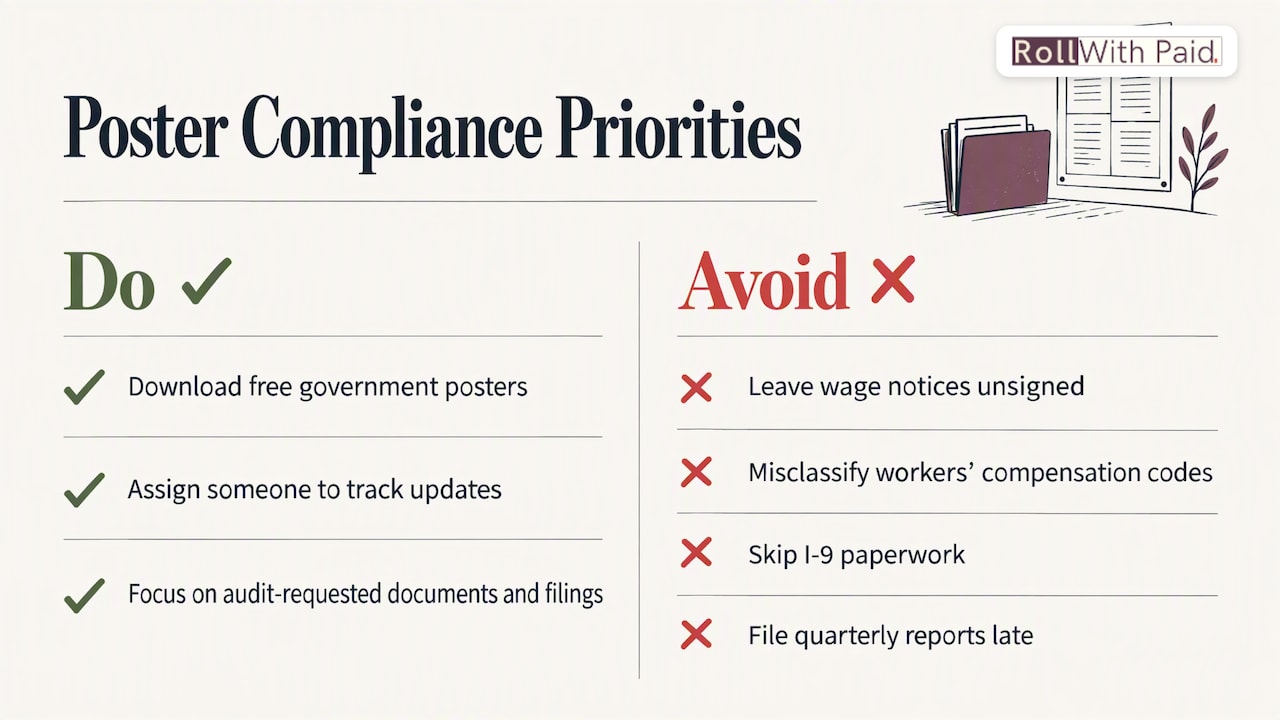
That is why we don’t treat posters as a product. For our clients, notices sit inside an audit-ready process: payroll execution, HR compliance, onboarding paperwork and the Employer of Record structure that spreads legal liability and workers’ compensation risk. Traditional providers often turn cannabis operators away, and the gaps that creates are exactly where penalties start.
Our advice is plain. Download the free government posters. Put someone on the hook for updates. Then spend your real attention on the documents and filings that auditors ask for after they have glanced at the wall.
— Leah Kollross
When it makes sense to bring in a partner
If you run a dispensary, a cultivation facility, or a multi-state operation, notices are only one of many compliance moving parts. Roll With Paid offers Employer of Record, payroll execution, HR and compliance solutions, onboarding and multi-state hiring support, and time and attendance tools, built for businesses in high-risk industries. Our rate is based on gross payroll and varies by worker classification code and headcount, with an optional flat-rate HR retainer. See the pricing page or our services to see how it works.
If you operate across state lines, start with our guide to audit-ready multi-state cannabis payroll. If you are weighing different structures, understanding Employer of Record for high-risk industries explains the model.
FAQ
Are online labor law posters legit?
They are legitimate when they match what the agencies publish. The DOL provides required federal posters free, so a paid vendor is selling convenience, not legal authority. Check that any poster you buy is the current version and covers your state and locality.
Where is the best place to order labor law posters?
Start with the agencies themselves: the DOL for federal posters and your state labor department for state ones. In Minnesota, the DLI offers its posters at no cost. Pay a vendor only if you want automatic replacements across several locations.
Can I print my own labor law posters?
Yes. The DOL provides electronic copies for printing, and the DLI says its Minnesota posters fit on standard letter-size paper. Print in the size and legibility the agency specifies, and replace them when a new version is released.
Is the Minnesota wage theft notice a poster?
No. It is a written notice that each employee receives at the start of employment, with a signed copy kept on file. Separately, you must display the posters the DLI requires, such as the minimum-wage poster.
Do cannabis businesses need special labor posters?
Often, yes. Besides the federal and state notices every employer posts, cannabis employers should check state safety posters and any notice tied to their testing policy. In Minnesota, an employer with a drug and cannabis testing policy must post notice that the policy exists. Confirm specifics with your state agency or a compliance advisor.
Sources
- U.S. Department of Labor: Workplace Posters
- U.S. Department of Labor: Posters FAQ
- DOL elaws FirstStep Poster Advisor
- EEOC: Know Your Rights poster
- EEOC: FAQ about the revised poster
- EEOC: updated poster release
- OSHA: 29 CFR 1903.2
- OSHA: 2018 interpretation on exposure records and the poster
- OSHA: Occupational allergies and asthma in cannabis cultivation
- Minnesota DLI: Workplace posters
- Minnesota DLI: Wage theft law
- Minnesota DLI: Wage theft Q&A
- Minnesota Statutes 181.952
Recommended
- Avoid Wage Liability in 20 States: PTO vs Sick Leave Rules for US HR
- Minnesota Paid Leave: Employer Obligations After Launch
Roll With Paid. is not a law firm and does not provide legal advice. This article summarizes Minnesota law as of August 2026 and is general information only. Tip arrangements are fact-specific; before changing a policy, consult employment counsel or contact DLI Labor Standards at 651-284-5075.