
Best Harassment Training for Employers in 2026: Compared
The best harassment training is the one that fits where your people actually work, the roles they hold and the risks in your shop or grow, and that sits inside a real complaint process. For most small and mid-size U.S. employers, that means an online course for employees and a longer one for supervisors. Larger or higher-risk teams may want live, instructor-led sessions on top. Below we compare the main options with prices and formats, explain the multi-state traps, and flag what cannabis and other high-risk employers should look for.
TL;DR
- Online, self-paced courses (CalChamber, Emtrain, SexualHarassmentTraining.com, AltaClaro) are the cheapest way to train everyone and keep completion records. Published prices run from $14.99 to $99.99 per seat depending on volume and vendor.
- Instructor-led training (such as Seyfarth at Work) costs more to run but suits supervisors and teams where role-play and live Q&A matter.
- Work location decides which rules apply, not where you are headquartered, so multi-state employers should verify each state and city.
- Training alone is not enough. The EEOC points to leadership accountability, clear policies and working complaint procedures as the foundation.
- Roll With Paid is not a course publisher. We build the HR compliance layer around whichever training you choose.
Table of Contents
- How to judge harassment training before you buy
- Harassment training options compared
- Multi-state employers: where training rules get complicated
- What cannabis and other high-risk workplaces should look for
- Training is one part of prevention
- Our perspective: buy the course, then build the system
- Where Roll With Paid fits
- Which option fits which employer
- FAQ
- Sources
How to judge harassment training before you buy
Most courses cover the same federal basics: what harassment is, protected characteristics, retaliation, and how to report. The differences that matter are practical, so judge each option on six points.
- Format. Self-paced online, live virtual, or on-site. Shift-based teams often need something that works on a phone between tasks.
- Audience split. Supervisors carry different duties than line staff, such as what to do when someone tells them about a problem. Look for a separate, longer supervisor course.
- Interactivity. Scenario-based videos, quizzes and role-play outperform a slide deck you click through. Some state rules also set interactivity requirements.
- State coverage. A course built for “all other states” will not necessarily satisfy a state or city with its own mandate.
- Records. You want completion reports, progress tracking and a way to assign and remind, because an audit or a lawsuit will ask for proof.
- Customization. Can you add your own policy, reporting channel and industry examples?
Price matters, but at the per-seat figures below it is rarely the deciding factor. A cheap course that does not fit your state or your workplace costs more than the fee.
Harassment training options compared
The table summarizes what each provider publishes. Prices are the figures on each provider’s own page, with the year of the page where we know it. Prices change, so confirm on the provider’s site before you buy.
| Provider | Format | Audience | Published price | Notes |
|---|---|---|---|---|
| CalChamber Multi-State Employee | Online, self-paced, 1 hour | Non-supervisors | $21.99 per course | One year from purchase to assign and complete |
| CalChamber Multi-State Supervisor | Online, self-paced, 2 hours | Supervisors | $34.99 per course | Adds supervisor commentary |
| Emtrain Preventing Workplace Harassment | Online, 30, 60 or 120 minute versions | Employees and supervisors | Quote-based on its page | One course for all states, updated annually |
| Seyfarth at Work | Instructor-led, on-site or virtual | Teams and supervisors | Not published | Interactive, role-play based |
| SexualHarassmentTraining.com | Online | Employees and supervisors | $29.99 per seat (1 to 9) down to $14.99 (200 to 299) | Volume pricing |
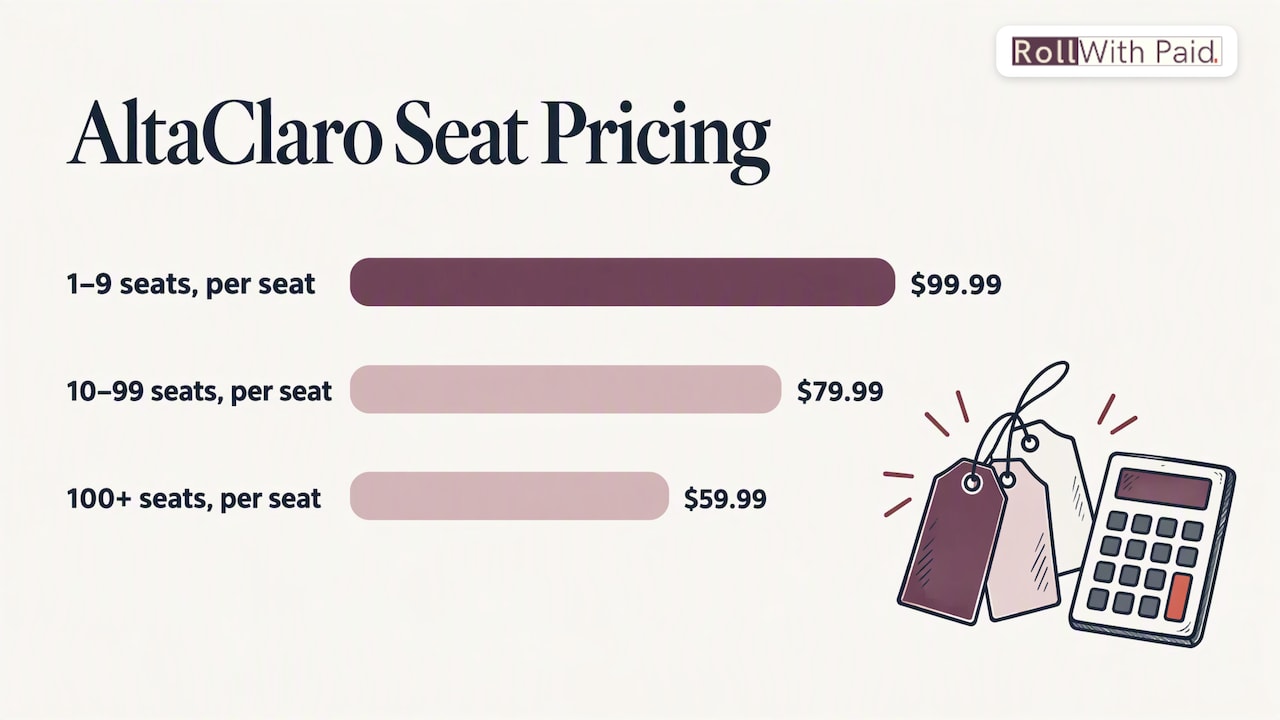
| AltaClaro (2020 price list) | Online | Employees and supervisors | $99.99 per seat (1 to 9), $79.99 (10 to 99), $59.99 (100+) | Corporate pricing |
| LightGabler LLP (2019 price list) | Online videos | Companies by headcount | $950 up to 500 employees, $1,200 for 501+ | Unlimited access, law firm |
| ServSafe | Online, restaurant-specific | Employees and managers | $23 employees, $32 managers | Built for food service |
CalChamber multi-state courses
CalChamber’s multi-state employee course is a one-hour, self-paced online program at $21.99. It uses workplace scenarios, attorney commentary, interactive quizzes and bystander-intervention content. It works on desktop and mobile, offers text or audio, lets learners self-register, and produces completion reports. Employers get one year from purchase to assign and finish the course.
The supervisor version runs two hours at $34.99 and adds supervisor-focused commentary on the same federal-law and best-practices framework.
The catch is scope. This is a best-practices course for states other than California, Connecticut, Delaware, Illinois, Maine and New York, which are the jurisdictions with their own training rules. If you have workers in those states, you need a different product. For a single-site employer elsewhere, it is a strong, low-cost default.
Emtrain
Emtrain’s Preventing Workplace Harassment course comes in Part A, Part B and combined formats lasting 30, 60 or 120 minutes. The company describes it as a single course for all states, updated annually and intended to meet state and federal mandates. Features include realistic video scenarios, an anonymous Ask the Expert tool, employee-sentiment surveys, more than 50 machine-translation options, optional timing, policy acknowledgment and customization.
The translation options and customization are the standouts for a workforce with mixed languages or a distinct culture. The sentiment surveys also help with the part training usually misses: finding out whether people believe the complaint process works. Pricing is not shown on the product page, so you will need a quote.
Seyfarth at Work
Seyfarth at Work’s Harassment and Conduct Training is instructor-led, offered on-site and virtually, and built around interactive exercises, props, role-play and Q&A in plain language. The firm also offers training across several delivery platforms for jurisdictions with required programs: California, Connecticut, Delaware, Illinois, Maine, New York State, Chicago and New York City.
Live training is the better choice for supervisors, for teams that have had incidents, or when leadership wants a room full of people to hear the same message together. It costs more than a per-seat online course, and the price is not published, so request a quote.
SexualHarassmentTraining.com and AltaClaro
SexualHarassmentTraining.com publishes organizational pricing from $29.99 per seat for 1 to 9 employees down to $14.99 per seat for 200 to 299 employees. That is the lowest published per-seat range in this comparison, and it favors mid-size teams.
AltaClaro lists corporate pricing at $99.99 per seat for 1 to 9 seats, $79.99 for 10 to 99 and $59.99 for 100 or more. That page dates from 2020, so treat the numbers as a floor for comparison and ask for a current quote.
LightGabler
LightGabler LLP is a California law firm that charged $950 for unlimited access to its online training videos for companies with up to 500 employees, and $1,200 for companies with 501 or more, according to a 2019 page. A flat fee can be attractive for a larger headcount, though a firm-built video library may be lighter on tracking than a full learning platform. Confirm current terms.
ServSafe
ServSafe offers restaurant-specific sexual harassment courses at $23 for employees and $32 for managers. It is not a fit for a dispensary, but it shows what industry-specific content looks like: examples drawn from the work your people actually do.
Multi-state employers: where training rules get complicated
If you run locations in more than one state, start here. Training compliance follows where an employee performs their work, not where you are headquartered or incorporated, so multi-state employers need to match training to each employee’s work location. The same source notes that a single generic course may not satisfy every state, because interactivity and content requirements differ.
Some examples of how much the rules vary:
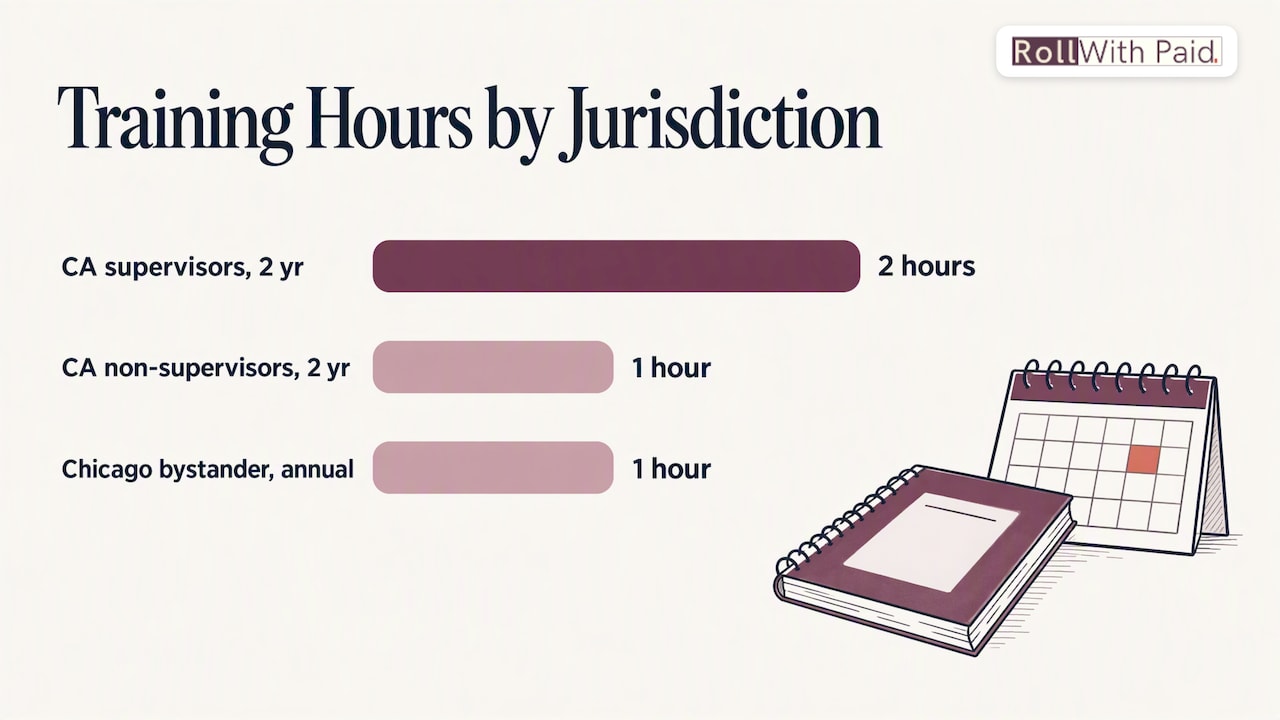
- California requires 2 hours of training for supervisors and 1 hour for non-supervisors every 2 years for employers with 5 or more employees (Gov. Code § 12950.1).
- Chicago requires a separate annual hour of bystander intervention training, and New York City requires bystander-intervention content within its annual training, as of September 2026.
Our practical approach for a multi-state operator:
- List every work location by state and city, including remote workers.
- Check each against the state’s labor or human rights agency for training mandates (including Minnesota, if that is where you operate).
- Buy a jurisdiction-specific course where a mandate exists, and a multi-state course for the rest.
- Keep one record per employee showing course, date and score.
For the payroll and onboarding side of multi-state hiring, see our guide to audit-ready multi-state cannabis payroll.
What cannabis and other high-risk workplaces should look for
We have not found a harassment course on the market written specifically for cannabis, so the job is to choose a flexible course and layer your own context on top. A few features matter more in this industry than in an office:
- Customer-facing exposure. Budtenders, delivery drivers and security staff deal with the public all day. Pick a course with bystander-intervention content and add your own policy on what staff do when a customer crosses a line.
- Shift work and mixed schedules. Mobile access and self-paced timing let grow and retail staff finish training without pulling a shift.
- Small, tight-knit crews. In a small team, reporting to a manager who is also a friend is hard. Look for anonymous reporting or Ask the Expert features, and offer a second reporting route outside the direct supervisor.
- Language mix. Machine translation options help, though review them before relying on them for legal content.
- Records you can hand over. Cannabis employers face frequent inspections and audits. Completion reports and policy acknowledgments should be easy to export.
Whichever course you choose, tie it to a place where concerns go. Our guide to incident reporting software for cannabis employers covers that.
Training is one part of prevention
The EEOC’s Select Task Force on harassment found that employers should make training part of a holistic culture of non-harassment, starting at the top, with leadership accountability, clear policies and complaint and reporting procedures. Training alone is not enough.
The cost of getting this wrong is real. In one EEOC case, a settlement with Lowe’s required comprehensive training, revised policies, complaint tracking and reporting, plus $1.72 million in monetary relief for three workers. Notice how much of that settlement is about systems rather than a one-time course.
Here is a short prevention checklist that goes with any course:
- A written anti-harassment policy, acknowledged by every employee at hire. A handbook platform makes this easier across states.
- At least two reporting channels, one of them outside the direct chain of command.
- A documented investigation process with timelines and someone trained to run it.
- A rule that managers who receive a complaint must escalate it the same day.
- Consequences for retaliation that are as visible as the consequences for harassment.
- Regular training refreshers and a way to check that people trust the system.
Our perspective: buy the course, then build the system
We work with dispensaries, cultivators and other high-risk employers that traditional payroll providers often turn away, and the pattern is consistent. The training course gets bought. What gets skipped is everything around it: the signed policy in the file, the person who actually receives complaints, the record showing a supervisor escalated a concern. When an audit or a claim arrives, the course certificate is the smallest part of the file.
Our advice is plain. Pick a reputable course that fits your states and roles, and do not agonize over the difference between a $22 and a $35 seat. Spend that energy on the process: who hears a complaint, how fast they act, and where it is written down. That is the work that makes an employer audit-ready, and it is also what reduces the legal exposure that drives up insurance and workers’ compensation costs.
If you are growing across state lines, assume that each new location brings its own training and policy requirements, and budget the administrative time before you open the doors, not after the first complaint.
— Leah Kollross
Where Roll With Paid fits
We do not sell harassment courses, and we would rather say so than pretend. What we do is run the HR and compliance work that a course depends on. Through our Employer of Record model, we handle payroll execution, onboarding, I-9 support, policy documentation and HR compliance for cannabis and other high-risk businesses, so training assignments, signed policies and incident records live in one organized file. Our rates depend on gross payroll, worker classification code and headcount, with an optional flat-rate HR retainer, and you can review how that works on our pricing page. To see how the pieces fit for your operation, start at rollwithpaid.com.
For more on day-to-day compliance habits, read our HR compliance tips for dispensaries and cultivations.
Which option fits which employer
| Your situation | Where to start |
|---|---|
| One location in a state without its own training mandate, small team | CalChamber multi-state employee and supervisor courses, or SexualHarassmentTraining.com |
| Mixed-language workforce, wants culture measurement | Emtrain |
| Supervisors need live practice, or a past incident | Seyfarth at Work instructor-led sessions |
| 200 or more employees and budget sensitivity | Compare SexualHarassmentTraining.com volume tiers and LightGabler’s flat fee |
| Locations in California, Connecticut, Delaware, Illinois, Maine, New York, Chicago or NYC | A jurisdiction-specific course; confirm with the provider that it meets the local rule |
Whatever you pick, ask each vendor three things before you pay: which jurisdictions the course is built to satisfy, what the completion report shows, and how long you have to assign it after purchase.
FAQ
How often should employees take harassment training?
It depends on where they work. California, for example, requires training for supervisors and non-supervisors every 2 years for covered employers, while Chicago and New York City call for annual training. Many employers choose an annual refresher regardless, since new hires and changing policies make a yearly cadence easier to track.
Should supervisors take a different course than other employees?
Yes, in most cases. Supervisors need to know how to receive and escalate a complaint, not just recognize harassment. The CalChamber supervisor course runs two hours against one hour for employees, and California’s rule follows the same split.
Is online training enough, or do we need live sessions?
Online courses satisfy many employers’ needs and make records easy. Live, instructor-led sessions add role-play and Q&A, which helps supervisors most. Check your state or city rules, because some mandates set interactivity requirements.
Does training protect us from a harassment claim?
It helps, but it is not a shield on its own. The EEOC stresses that training works only alongside leadership accountability, clear policies and functioning complaint procedures. Keep records of completion, acknowledged policies and how complaints were handled.
Sources
- Preventing Workplace Harassment Training Course, Emtrain
- Harassment Prevention Training, Multi-State Employee, CalChamber
- Harassment Prevention Training, Multi-State Supervisor, CalChamber
- Harassment and Conduct Training, Seyfarth at Work
- Plan and Pricing, SexualHarassmentTraining.com
- AltaClaro sexual harassment prevention training
- Training Programs, LightGabler LLP
- ServSafe Products List
- State Compliance Training Requirements for Remote Employees, Coggno
- State-by-State Bystander Intervention Training Requirements, Coggno
- Sexual Harassment Prevention Training, Traliant
- Select Task Force on the Study of Harassment in the Workplace, EEOC
- Rampant sex harassment costs Lowe’s $1.7 million, EEOC
Recommended
- Cannabis HR Calendar 2026: IRS Deadlines, OSHA Scrutiny, DEA Changes
- 12 Employee Survey Tools for HR Teams: Buyer Picks and Payroll Option
- HR First Incident Reporting Software for Cannabis Employers
Roll With Paid. is not a law firm and does not provide legal advice. This article summarizes Minnesota law as of August 2026 and is general information only. Tip arrangements are fact-specific; before changing a policy, consult employment counsel or contact DLI Labor Standards at 651-284-5075.