
6 COBRA Administrators HR Teams Should Shortlist: Roll With Paid Tops
Among the top COBRA administrators HR teams evaluate this year, five names come up repeatedly: TASC, Advanced Benefit Strategies, Inc., CobraHelp, Kept, Inc., and ebm. For employers who want notices, premium collection, and payroll data working off one system rather than three, some vendors specialize in integrated solutions tailored for high-risk industries and multi-state employers. Mid-market and enterprise buyers with heavier benefits stacks tend to fit better with TASC or ebm. The comparison table below breaks down each vendor by service scope, integration, and pricing model.
TL;DR:
- Employers in high-risk or regulated industries should consider vendors like Roll With Paid that integrate payroll and COBRA management to minimize compliance risks and late filings.
- For mid-market or benefits-heavy organizations, TASC and ebm offer broad benefits platform integration, though implementation complexity increases with multiple benefit modules.
- Smaller employers seeking manual, human-centered administration may find ABS or CobraHelp better suited due to their focus on personalized service and participant experience.
- Vendors differ significantly in how they trigger events and handle data handoffs; automation and proper onboarding processes are essential to avoid compliance failures.
- An effective takeover process requires thorough data cleanup, parallel runs, and verifying carrier notifications, especially for multi-carrier or multi-jurisdictional plans.
Table of Contents
- Best COBRA Administrators Compared: Coverage, Compliance, and Cost
- What Each COBRA Administration Company Actually Offers
- How to Choose a COBRA Administrator: Criteria, Questions, and Red Flags
- Vendor Takeover: Timeline, Data Handoffs, and Cutover Checklist
- Why Roll With Paid Fits Compliance-Focused Employers
- Outsource COBRA or Keep It In-House?
- Get Started With Roll With Paid for Payroll-Integrated COBRA Compliance
- Sources
- FAQ
Best COBRA Administrators Compared: Coverage, Compliance, and Cost
Six vendors made this shortlist because each one clears three bars: real COBRA notice and election workflows (not a bolted-on feature), documented compliance handling that would survive an audit, and enough integration flexibility to plug into an existing payroll or HRIS setup. Vendor directories like SHRM’s benefits administration outsourcing category list dozens of firms claiming COBRA capability, but most either bundle it as an afterthought inside a broader benefits platform or lack the direct-billing and carrier-coordination features that actually reduce HR’s workload.
The table below lines up the six administrators against the dimensions that matter most in a vendor decision: who each one fits best, what’s actually included, how well it talks to payroll systems, and how it handles fees.
| Administrator | Best For | Service Scope | Payroll/HRIS Integration | Pricing Model |
|---|---|---|---|---|
| Roll With Paid | High-risk industries and employers wanting payroll + benefits + compliance in one vendor | Notices, elections, premium collection, Employer of Record | Native, built around payroll from the start | Bundled into payroll/HR service fee |
| TASC | Mid-market to large employers with broad benefits stacks | Notice management, participant portal, direct billing | Standard file-feed integrations | Per-participant fee plus setup |
| Advanced Benefit Strategies, Inc. (ABS) | Small-to-mid employers wanting a specialist administrator | Notice production, premium collection, election tracking | Manual/file-based | Flat monthly plus per-event fee |
| CobraHelp | Employers prioritizing participant experience and collections | Participant portals, direct billing, payment options | File-feed integrations | Per-participant billing |
| Kept, Inc. | Employers wanting modern platform and self-service | Notices, elections, automation, self-service tools | API-based, tech-forward | Tiered platform pricing |
| ebm | Employers needing carrier notification and consolidated reporting | Notices, carrier coordination, consolidated reporting | File-feed integrations | Per-participant fee |
A few things stand out once you look across the row instead of down a single column:
- Roll With Paid is the only entrant here built around payroll first, which matters if your qualifying events (terminations, hour reductions) already live in a payroll system rather than a standalone HR tool.
- TASC and ebm both lean on mature, broad-scope platforms, which fits employers who need COBRA folded into a larger benefits administration stack rather than handled as a single point solution.
- CobraHelp and ABS are narrower by design. That’s not a weakness. It means less platform overhead if COBRA is genuinely the only thing you’re outsourcing.
- Kept, Inc. is worth a look if your team wants participants doing more self-service and less phone-tag with an administrator.
None of these vendors are interchangeable once you get past the surface-level notice-and-bill function. The differences show up in how each one handles the handoff between your payroll system and the qualifying-event trigger, which is where most COBRA compliance failures actually happen.
What Each COBRA Administration Company Actually Offers
Every administrator on this list will send notices and collect premiums. The differences that matter show up in how they trigger events, document the process, and support the humans on both ends of a qualifying event.
Roll With Paid built its Employer of Record model specifically for high-risk industries, cannabis operators chief among them, where compliance missteps carry outsized legal and licensing exposure. Because payroll, benefits, and HR compliance sit inside one system rather than three vendors passing files back and forth, a termination or hours reduction that triggers a COBRA-qualifying event gets flagged automatically instead of waiting on a manual data export. That structure is the standout: most COBRA administrators receive qualifying-event data secondhand from a payroll provider, which introduces a lag and a point of failure. Roll With Paid removes that handoff entirely for clients already running payroll through it. The client relationship may include a dedicated point of contact rather than a call queue, and some clients report zero late filings under their compliance model, reflecting audit-ready recordkeeping. Implementation for existing payroll clients typically means no new data feed at all; for employers switching payroll providers to Roll With Paid, onboarding runs through the standard payroll takeover process with COBRA administration layered in.
TASC has been in the benefits administration business for decades and treats COBRA as one module inside a much larger suite that also covers FSA, HSA, and direct billing for other benefit types. That maturity shows up in its participant portal and its ability to absorb complex, multi-plan employer setups without custom engineering. The tradeoff: employers who only want COBRA handled, and nothing else, may find themselves paying for platform breadth they don’t use. Implementation follows a standard data-mapping and parallel-run process, and its long track record in benefits services is the trust signal most buyers cite when shortlisting it.
- Best for: employers already using or considering TASC for other benefit types
- Standout: mature platform with broad benefits administration built in
- Watch for: onboarding complexity scales with how many other modules you activate
Advanced Benefit Strategies, Inc. (ABS) positions itself as a specialist rather than a platform company. Its COBRA notice production and premium collection processes are hands-on, with a dedicated client service structure rather than a purely self-service portal. That makes ABS a reasonable fit for smaller employers who want a human answering questions about a specific qualifying event rather than a knowledge base article. The tradeoff is less automation: expect more manual file exchange during takeover and less API-level integration than a tech-forward competitor offers.
- Best for: small-to-mid employers who want a specialist administrator with direct client service
- Standout: hands-on administration with a dedicated service team
- Watch for: fewer automated integration options than platform-first vendors
CobraHelp is built around the participant side of the transaction. Its portals and direct-billing tools are designed to reduce the friction that causes late payments and coverage lapses, which matters because a mishandled premium collection creates just as much compliance exposure as a missed notice deadline. Employers who hear frequent participant complaints about confusing payment processes with their current administrator often move to CobraHelp specifically to fix that friction point.
- Best for: employers whose current pain point is participant confusion or missed payments
- Standout: participant-focused portals and direct-billing features
- Watch for: evaluate its payroll integration options closely if you need automated event triggers
Kept, Inc. brings a tech-enabled approach to COBRA as part of a broader HR and benefits service. Its API-based integration and self-service tools appeal to HR teams that want fewer manual touchpoints and are comfortable trusting automation to route notices and track elections. That same automation-first design means the platform rewards employers with clean, well-structured HRIS data going in. Messy source data will surface as errors faster on a Kept, Inc. implementation than on a more manual competitor.
- Best for: employers who want modern platform integration and participant self-service
- Standout: tech-forward integrations and workflow automation
- Watch for: data quality on your end determines how smoothly automation performs
ebm rounds out the shortlist with a focus on carrier coordination, notifying the right insurance carriers of the right participant status changes, and consolidated reporting across a whole benefits program, not just COBRA. That coordination layer matters for employers running multiple carriers or self-funded plans where a missed carrier notification creates real coverage gaps for participants.
- Best for: employers needing carrier notification across multiple plans and consolidated reporting
- Standout: carrier coordination and integrated benefit services
- Watch for: confirm reporting formats match what your finance or audit team actually needs
How to Choose a COBRA Administrator: Criteria, Questions, and Red Flags
Six criteria separate a COBRA administration company that will hold up in an audit from one that will leave you exposed. Compliance controls come first: ask exactly how the vendor tracks the 30-day window employers have to notify the administrator of a qualifying event, since that window is the single most common failure point in COBRA compliance. Takeover planning matters just as much. Vendors that show up to an RFP without a documented data-mapping and parallel-run strategy tend to score poorly for good reason: buyers who skip this step often discover gaps only after a real qualifying event falls through the cracks.
Payroll integration, participant support quality, pricing transparency, and data security round out the list. A vendor that can’t explain in plain terms how it handles HIPAA-covered participant data, or that hedges on whether it can integrate with your existing HRIS, is telling you something about how the rest of the relationship will go.
Ask these ten questions on the first vendor call or inside the RFP itself:
- How do you receive qualifying-event data, and how fast after the event does a notice go out?
- What does your standard takeover timeline look like, start to finish?
- Can you show a sample audit-ready case file for a single qualifying event?
- How do you handle the 20-employee threshold question if we’re close to that line?
- What’s your process if a participant misses a premium payment?
- Do you charge the 2% administrative fee to participants, and is that itemized separately from your service fee to us?
- What payroll/HRIS systems have you integrated with before, specifically?
- Who is our day-to-day point of contact, and what are your call center hours?
- What happens during a parallel run, and how long does it typically last?
- Can you provide two references from clients in a similar size range or industry?
Red flags worth walking away from: a vendor that can’t produce a sample audit file, one that treats the 30-day notification window as “not really their problem,” or one whose pricing quote arrives without a clear breakdown of what’s billed to you versus what’s billed to participants.
Pro Tip: Ask for the audit-ready case file before you ask about price. A vendor that hesitates on documentation will cost you more in a compliance review than it saves you on the invoice.
Vendor Takeover: Timeline, Data Handoffs, and Cutover Checklist
A typical COBRA vendor takeover runs through five phases: discovery, data transfer, testing, cutover, and a parallel run. Discovery usually takes one to two weeks and covers plan documents, current participant rosters, and carrier contacts. Data transfer is where most delays happen, largely because employers underestimate how much cleanup their roster data needs before a new administrator can ingest it cleanly.
Vendors typically require: active and COBRA-eligible participant rosters, summary plan descriptions, carrier contact information, and current premium amounts by plan tier. Format matters more than most HR teams expect. A flat spreadsheet with inconsistent date formatting will bounce back for correction and add days to the timeline that a clean, standardized export would have avoided.
Integration is where the takeover either pays off or becomes another manual process. HRIS/payroll integration that automates qualifying-event notifications removes the single most common compliance failure point, which is the 30-day employer notification window slipping because someone forgot to flag a termination. Buyer-side evaluation increasingly favors administrators that treat notices and elections as one case-tracked workflow rather than separate manual steps, and payroll-linked providers tend to reduce the manual errors that cause missed triggers in the first place.
Once cutover happens, don’t skip the parallel run. Running your old and new process side by side for one full billing cycle catches mismatched premium amounts and missing participants before they become compliance problems.
- Confirm every active COBRA participant transferred, not just newly eligible ones.
- Reconcile premium amounts collected under the new vendor against your last invoice from the old one.
- Verify carrier notifications went out correctly for at least one full cycle.
- Document the parallel-run results in case an auditor asks about the transition later.
Why Roll With Paid Fits Compliance-Focused Employers
Leah covers payroll and HR compliance for high-risk industries, with a particular focus on how cannabis operators and other regulated employers manage benefits exposure without a dedicated compliance department.
Roll With Paid was built around the Employer of Record model, which centralizes payroll, benefits, and compliance functions that most employers otherwise juggle across three or four separate vendors. That structure matters most for a specific set of buyers:
- Cannabis dispensaries and cultivation operators, where a compliance misstep carries licensing risk on top of the usual legal exposure. Roll With Paid’s approach to high-risk industries was built for exactly this exposure.
- Multi-state employers juggling different wage, hour, and benefits rules across jurisdictions, where a single integrated system catches conflicts a fragmented setup would miss.
- Businesses that specifically want one vendor handling payroll, benefits, and compliance rather than a vendor for each function, reducing the number of handoffs where a qualifying event can slip through unnoticed.
Some vendors report very low late filing rates across their client base under integrated compliance models, reflecting audit-ready documentation practices that meet evaluation criteria.
Outsource COBRA or Keep It In-House?
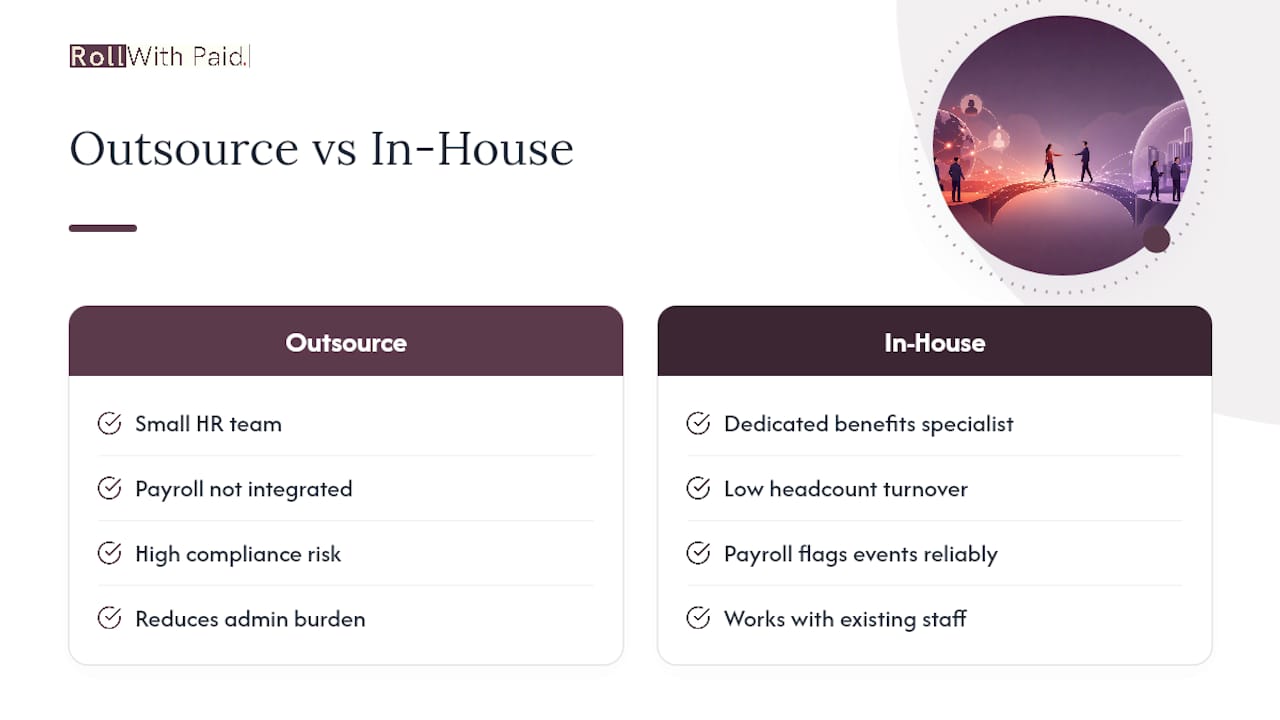
Outsourcing makes sense once three signals show up together: your HR team is small enough that COBRA administration competes with higher-priority work, your payroll system doesn’t talk to a dedicated COBRA platform, and your compliance risk profile, cannabis, healthcare, or any heavily regulated industry, can’t absorb a missed notice deadline. Outsourcing genuinely reduces both the administrative burden and the compliance risk that comes from handling qualifying events manually inside a stretched HR function.
Keeping it in-house still works for employers with a dedicated benefits specialist, low headcount turnover, and payroll software that already flags qualifying events reliably. If none of that describes your operation, don’t sign a multi-year contract on faith. Pilot one vendor against a single plan or business unit first, run one full billing cycle, and check the audit trail before rolling it out company-wide. That single-cycle test tells you more about a vendor’s real performance than any RFP response will.
— Leah
Get Started With Roll With Paid for Payroll-Integrated COBRA Compliance
Roll With Paid gives you one vendor for payroll, benefits, and COBRA compliance instead of stitching together a payroll provider, a benefits administrator, and a separate COBRA vendor that don’t talk to each other. That matters most for cannabis operators and other high-risk employers, where a missed 30-day notification window carries licensing exposure on top of the usual legal risk.

Getting started is straightforward: a short audit of your current payroll and benefits setup, a review of your active COBRA-eligible population, and an onboarding checklist that maps your existing data into Roll With Paid’s system before cutover. Cannabis operators in particular benefit from the firm’s dispensary and cultivation compliance experience, which covers far more than COBRA alone. If payroll accuracy is also on your radar, it’s worth reviewing how workers’ comp classification codes interact with the same compliance framework. Visit Roll With Paid to request an audit of your current setup and see what a consolidated payroll, benefits, and compliance vendor looks like in practice.
Sources
- An employer’s guide to group health continuation coverage under COBRA — U.S. Department of Labor
- Vendor directory — SHRM: COBRA Administration category
FAQ
Is There a 2% Administrative Fee for COBRA?
Federal guidance allows employers to charge participants a reasonable administrative fee, commonly referenced as up to 2% of the premium, to cover the cost of administering COBRA coverage. This fee is separate from the premium itself and is paid by the participant, not the employer.
What Are Third-Party Administrators for COBRA?
Third-party administrators are outside vendors, like the ones compared in this article, that handle COBRA notices, elections, and premium collection on an employer’s behalf. Employers remain legally responsible for compliance even when a third-party administrator manages the day-to-day process.
Who Is the Plan Administrator for COBRA?
The plan administrator is typically the employer or the entity named in the plan document as responsible for administering the group health plan, even when day-to-day COBRA tasks are outsourced to a vendor. That legal responsibility doesn’t transfer away just because a third-party administrator handles notices and billing.
What Is the COBRA Loophole?
There’s no official “loophole” in COBRA law, but the term often refers to gaps that occur when employers miss the 30-day notification window or misapply the 20-employee threshold, leaving eligible participants without proper notice. Vendors with automated, payroll-integrated event triggers, like the model Roll With Paid uses, are built specifically to close that gap before it becomes a compliance problem.
Recommended
- Understanding Employer of Record for High-Risk Industries
- Workers’ Comp Classification Codes: Getting Them Right
Roll With Paid. is not a law firm and does not provide legal advice. This article summarizes Minnesota law as of August 2026 and is general information only. Tip arrangements are fact-specific; before changing a policy, consult employment counsel or contact DLI Labor Standards at 651-284-5075.