
Avoid Lawsuits: What U.S. Employers Must Put in Adverse Action Notice
An adverse action notice is a legal disclosure required under the FCRA and ECOA whenever a creditor, employer, insurer, or landlord takes a negative action based on a consumer report. If you receive one, you have specific rights, including a free credit report within 60 days. If your business sends one, getting the content and timing wrong is one of the fastest routes to a lawsuit, especially for employers who skip the required pre-adverse step.
TL;DR:
- Proper documentation of every step, including timely pre-adverse notices and specific reasons, is essential to avoid costly legal violations.
- Automated or AI-driven decisions require detailed, factor-level explanations that accurately reflect the actual reasons behind a denial or adverse action.
- Sending generic or incomplete notices, such as vague reasons or missing CRA contact info, increases the risk of enforcement actions and damages.
- Keeping a verifiable record of notices, delivery method, and consent forms helps defend against disputes and regulatory scrutiny.
- Employers and organizations must be aware of separate state rules for insurance and housing decisions that add to federal notice requirements.
Table of Contents
- What Is an Adverse Action Notice Under Federal Law?
- What Must a Final Adverse Action Notice Include?
- How Do You Handle the Employment Pre-Adverse and Final Notice Steps?
- What Delivery Methods and Documentation Hold Up Best?
- What Should You Do After Receiving an Adverse Action Notice?
- What Are the Legal Risks of Getting This Wrong?
- What Should Compliant Notice Language Actually Look Like?
- Do Insurance and Housing Notices Follow Different Rules?
- How Should Automated and AI-Driven Decisions Handle Notices?
- What Common Mistakes Show Up in Real Adverse Action Scenarios?
- What If You Find an Error After the Notice Already Went Out?
- Roll With Paid’s Perspective on Operational Compliance
- How Rollwithpaid Supports Compliant HR Documentation
- Primary Sources for Verifying Adverse Action Requirements
- Sources
- FAQ
What Is an Adverse Action Notice Under Federal Law?
An adverse action notice is a legally mandated communication informing someone that an organization has taken a negative action, denial, termination, or unfavorable terms, based at least partly on information in a consumer report. The two federal statutes that govern this obligation are the Fair Credit Reporting Act (FCRA) and the Equal Credit Opportunity Act (ECOA), the latter implemented through Regulation B.
The rules overlap but aren’t identical. FCRA applies whenever a consumer report, credit report, background check, tenant screening file, that drives the decision. ECOA and Reg B apply specifically to credit transactions, regardless of whether a consumer report was involved at all. That distinction matters because a creditor can trigger Reg B obligations even without pulling a credit file, just by denying an application or changing terms unfavorably.
Common triggers you’ll recognize include:
- Denial of a credit card, auto loan, or mortgage application
- Approval at worse terms than requested (higher rate, lower limit, larger down payment)
- Employment rejection or termination tied to a background check
- Denial or non-renewal of an insurance policy based on a credit-based score
- Rejection of a rental application after a tenant screening report
One nuance business owners often miss: business credit applications get lighter ECOA treatment than consumer credit. Creditors extending business credit can generally provide a shorter, less detailed notice unless the business is a sole proprietorship, in which case consumer-level protections typically still apply.
What Must a Final Adverse Action Notice Include?
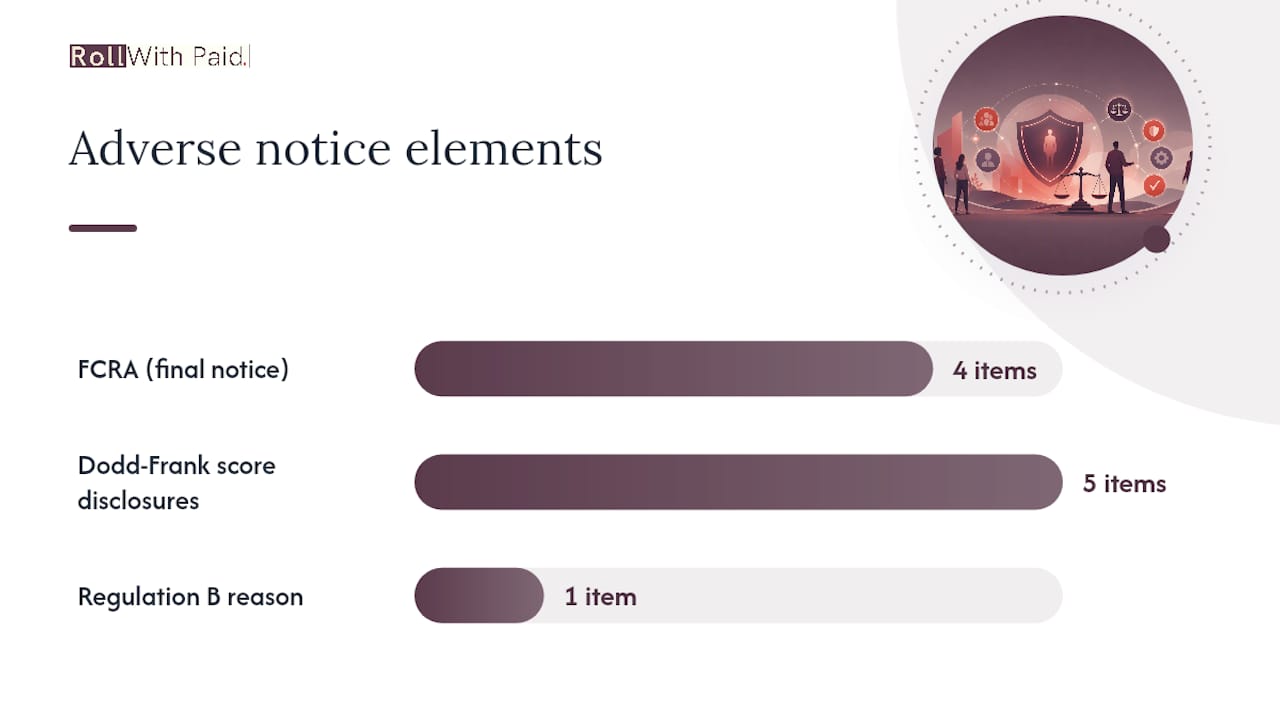
A compliant final notice under the FCRA needs four core elements, and missing any one of them is a common, expensive mistake. The notice must:
- Identify the consumer reporting agency by name, address, and phone number
- State clearly that the CRA did not make the decision and can’t explain the reason for it
- Inform the consumer of the right to a free copy of the report within 60 days of the notice
- Explain the right to dispute the accuracy or completeness of the report directly with the CRA
Statistic Callout: Consumers have a 60-day period from receiving the notice to request that free report from the credit reporting agency. That clock starts at delivery.
When a credit score influenced the outcome, Dodd-Frank layers on additional disclosures: the numeric score itself, the range of possible scores, the date the score was created, the identity of the scoring model’s provider, and the key factors that adversely affected the score (typically no more than four).
Regulation B adds its own requirement that sits apart from FCRA: creditors must state the specific principal reasons for denying credit, not generic categories. This is where a lot of organizations get sloppy. The CFPB has been explicit that creditors can’t lean on its own sample checklist of reasons when those checklist items don’t actually reflect why the applicant was denied. “Insufficient collateral” means nothing if the real reason was debt-to-income ratio. Regulation B requires the notice to name what actually drove the decision, and pairing generic checklist boxes with an actual algorithmic reason code is a mismatch examiners look for.
How Do You Handle the Employment Pre-Adverse and Final Notice Steps?
Employment background checks follow a two-step FCRA process that’s easy to get backwards, and getting it backwards is one of the most common ways employers end up defending a claim. Here’s the sequence:
- Send the pre-adverse action notice. Before you make any final decision, provide the applicant a copy of the consumer report you relied on, along with a copy of the Summary of Your Rights Under the FCRA. State plainly that no final decision has been made yet.
- Hold for a reasonable waiting period. The FCRA doesn’t specify an exact number of days, but five business days has become the common industry benchmark for giving the applicant a meaningful chance to respond or dispute something in the report.
- Review any dispute that comes in during the window. If the applicant contacts the reporting agency or you directly with a correction, pause and reassess before finalizing anything.
- Send the final adverse action notice. Once the waiting period passes without a disqualifying dispute, issue the final notice with the same core FCRA elements: CRA identity, non-decision statement, free report right, and dispute right.
Check your state law before locking in that five-day window. States with “ban the box” or fair chance hiring laws sometimes require a longer wait or extra steps before you can finalize a rejection.
Pro Tip: Log every notice with a timestamp, the delivery method, and the exact version of the report and Summary of Rights sent. If a dispute ever surfaces, that timeline is your best evidence that you followed the process correctly.
What Delivery Methods and Documentation Hold Up Best?
Adverse action notices can be delivered by mail, hand delivery, or electronically, but electronic delivery only satisfies the notice requirement if the recipient has given valid E-SIGN Act consent beforehand. You can’t assume an email address on file counts as consent to receive legal notices electronically.
Building a verifiable paper trail matters more than most organizations realize until they’re defending a claim. Practical documentation practices include:
- Using certified mail or tracked delivery for physical notices
- Logging email delivery with timestamps and read receipts where available
- Storing signed E-SIGN consent forms separately from the notices themselves
- Keeping the exact version of the report and disclosures sent, not just a template
When a notice goes out on behalf of multiple creditors, jointly, it must identify each creditor involved and either state the principal reasons each one relied on or clearly explain the applicant’s right to request those reasons.
Pro Tip: Registered mail or a logged electronic delivery system costs a little more upfront, but it’s the difference between “we can prove this was sent and received” and “we think it probably went out.”
What Should You Do After Receiving an Adverse Action Notice?
If you’re the one holding the notice, you have specific, time-limited rights, and missing the window can cost you leverage. Start here:
- Request your free report within 60 days. Contact the credit reporting agency named in the notice directly; most CRAs process these requests within days once identity is verified.
- Review the report line by line against your own records, loan statements, account histories, court records, before assuming the denial was justified.
- File a dispute in writing with the CRA if you find an error, and include copies of supporting documents, never originals. Most CRAs must investigate within 30 days of receiving a dispute.
- Request a statement of specific reasons if the notice only pointed you toward “other” or vague categories; ECOA gives you that right for credit decisions.
- Escalate to the CFPB or your state attorney general if the creditor or CRA ignores your dispute or the notice itself looks noncompliant.
Keep copies of everything you send and every response you get. If this turns into a formal complaint later, that record is what regulators will ask for first.
What Are the Legal Risks of Getting This Wrong?
Willful FCRA violations carry statutory damages between $100 and $1,000 per violation, and that’s before punitive damages or attorney fees enter the picture. Class actions are where this becomes existential: a template error repeated across thousands of notices multiplies that per-person exposure fast.
Statistic Callout: A single class of 5,000 mishandled notices at the low end of the willful-violation range already represents $500,000 in statutory exposure alone, before legal costs.
Courts have generally treated “willful” to include reckless disregard for the law, not just intentional violations, which means “we didn’t know” is a weak defense once you’ve been put on notice about the requirements.
The most common failures that trigger enforcement or lawsuits:
- Using the CFPB’s sample reason checklist without confirming it matches the actual decision factors
- Skipping the employment pre-adverse step and going straight to termination
- Sending vague reasons like “does not meet requirements” instead of specific principal factors
- Failing to document delivery or consent for electronic notices
Internal controls that meaningfully reduce risk include a standardized template review process, a delivery log, and a second set of eyes on any notice generated by an automated scoring system before it goes out.
What Should Compliant Notice Language Actually Look Like?
A final adverse action notice for a credit decision should include: the specific action taken, the CRA’s name and contact information, the non-decision statement, the 60-day free report right, the dispute right, and, when a score was used, the numeric score, score range, date, provider, and key adverse factors.
For employment, the pre-adverse notice needs a copy of the consumer report, a copy of the Summary of Rights, and a plain statement that no final decision has been made. The final employment notice mirrors the credit notice’s core disclosure elements once the waiting period closes.
Where organizations get into trouble is vague boilerplate. Compare these:
| Avoid | Use Instead |
|---|---|
| “Insufficient credit history” | “Length of credit history below 3 years on revolving accounts” |
| “Does not meet company standards” | “Criminal record includes a disqualifying offense within the past 7 years per company policy” |
| “Unfavorable report information” | “Reported delinquency on auto loan account within the last 12 months” |
| “Other” with no elaboration | The actual factor, or a clear statement of the right to request it |
Specific, factor-level language isn’t just better practice, it’s what CFPB guidance now expects when automated systems or complex models are involved.
Do Insurance and Housing Notices Follow Different Rules?
Insurance and housing decisions add their own layers on top of FCRA’s baseline requirements. Insurers who deny, cancel, or charge higher premiums based on a credit-based insurance score must issue an adverse action notice under FCRA, similar in structure to a credit notice: identify the CRA, disclose the free report right, and explain the dispute process. Many states add their own insurance-specific notice requirements on top of federal law, so check your state insurance department’s rules before finalizing a template.
Housing decisions get more complicated because they can trigger overlapping obligations. A landlord who denies an application or requires a larger deposit based on a tenant screening report owes an FCRA adverse action notice. If the decision also touches protected classes under the Fair Housing Act, national origin, familial status, disability, additional documentation and nondiscrimination review become relevant, separate from the FCRA notice itself.
ECOA technically covers credit transactions, not standard landlord-tenant screening, so most rental denials fall under FCRA rather than Reg B. But if a landlord extends financing terms as part of a rent-to-own or similar credit arrangement, ECOA’s specific-reasons requirement kicks back in.
The practical takeaway for insurers and housing providers: don’t assume a generic FCRA template covers you completely. Layer in state insurance notice rules and fair housing documentation standards on top of the federal baseline, and keep records showing the score-based or report-based factor that actually drove the decision.
How Should Automated and AI-Driven Decisions Handle Notices?
Algorithmic and AI-driven underwriting doesn’t get a pass on specificity, and the CFPB has said so directly. When a complex model or AI system contributes to a credit denial, the creditor still has to translate that decision into specific, accurate principal reasons a human can understand, not a generic checklist item that happens to be close enough.
This creates a real technical requirement, not just a legal one. Organizations using automated decisioning need models instrumented to produce contributor-level explanations that map back to the actual factors the model weighted most heavily. “The algorithm said no” is never an acceptable answer on a notice, and neither is picking the closest-sounding item from a standard reason-code list if it doesn’t reflect what the model actually flagged.

Practically, that means whoever builds or licenses the scoring model needs to work with compliance staff before deployment, not after a complaint arrives. Reason codes need to be mapped to plain-language explanations in advance, tested against real denial scenarios, and reviewed periodically as the model gets retrained. A model that shifts its weighting over time can quietly turn yesterday’s accurate reason code into today’s misleading one.
If your organization relies on a third-party vendor’s scoring engine, get contractual assurance that the vendor can supply factor-level explanations on demand, not just a score. You’re the one holding legal responsibility for the notice’s accuracy, regardless of who built the underlying model.
What Common Mistakes Show Up in Real Adverse Action Scenarios?
A few patterns show up again and again in enforcement actions and disputes, and most of them are avoidable with better internal review.
One frequent error: an employer sends the final termination notice on the same day as the pre-adverse notice, effectively skipping the waiting period entirely. Another: a lender uses the CFPB’s standard checklist verbatim, checking “excessive obligations” when the real driver was a recent late payment, because the checklist felt easier than writing an accurate reason.
A third common scenario involves multiple creditors on a joint application, where only one creditor’s name appears on the notice despite two or more parties reviewing the file. That omission alone can violate the multi-creditor disclosure requirement.
A fourth: organizations that deliver notices by email without ever securing valid E-SIGN consent, then can’t prove the notice was legally received when a dispute arises. And a fifth, increasingly common one: automated systems generate a notice using a generic reason template that hasn’t been checked against what the model actually flagged for that specific applicant.
The fix for nearly all of these is the same: build a review checkpoint before any notice goes out, whether it’s generated manually or by a system, so someone confirms the stated reasons match the actual decision factors and the timing sequence was followed correctly.
What If You Find an Error After the Notice Already Went Out?
Mistakes happen, an incorrect CRA address, a missing credit-score factor, a notice sent before the waiting period closed, and how you respond afterward matters almost as much as preventing the error in the first place.
The first step is issuing a corrected notice as soon as the error is discovered, restarting any relevant clock if the original notice’s timing or content was materially deficient. If the flaw affected the consumer’s ability to exercise their rights, for instance, an incorrect CRA phone number that blocked them from requesting their free report, treat the corrected notice as the operative one for calculating that 60-day window.
Document the correction internally: what was wrong, when it was caught, who caught it, and what the corrected version said. That record matters if a regulator or plaintiff’s attorney later asks why two versions of a notice exist for the same applicant.
If the error affected multiple recipients, a systemic template mistake rather than a one-off, treat it as a broader compliance review, not just a single fix. Check whether the same error appears in notices sent over the preceding weeks or months, and correct all of them rather than only the one that got flagged. Notify affected individuals proactively where the error was material rather than waiting for someone to complain.
Building this correction workflow into your compliance process before you need it, rather than improvising after the fact, is what separates a minor paperwork fix from a pattern that draws regulatory attention.
Roll With Paid’s Perspective on Operational Compliance
Getting the notice language right is only half the job. The other half is proving, months or years later, that you actually followed the process: the pre-adverse step, the waiting period, the correct final notice, all documented and timestamped.
That’s the same discipline that keeps payroll filings on time and workers’ comp classifications accurate. A business that treats adverse action documentation as a “quarterly fire drill” instead of a routine control usually has the same gaps in its payroll audit trail. Some payroll and HR providers work with high-risk industry employers, including cannabis operators, where audit-readiness is critical and margin for error is thin. Building consistent documentation habits into onboarding and HR compliance workflows is what turns a legal requirement into a manageable routine rather than a recurring source of anxiety.
— Leah
How Rollwithpaid Supports Compliant HR Documentation
Rollwithpaid is the practical alternative to piecing together compliance on your own, particularly if you’re operating in cannabis or another high-risk sector where traditional payroll providers won’t touch your account. Through its Employer of Record model, Rollwithpaid handles payroll execution, HR compliance, and onboarding documentation with the audit-ready recordkeeping that adverse action processes, and every other regulated HR function, depend on.

If your organization is still relying on scattered email chains and manual templates to track hiring decisions, that’s exactly the kind of gap that turns into legal exposure later. Rollwithpaid’s HR & Compliance Solutions build documentation habits into the onboarding process itself, so pre-adverse steps, waiting periods, and final notices don’t depend on someone remembering to log them. Review current service rates or reach out to talk through how an Employer of Record setup fits your hiring volume and risk profile.
Primary Sources for Verifying Adverse Action Requirements
Compliance teams should keep these primary sources on hand rather than relying on secondhand summaries. The CFPB’s Regulation B text covers notification timing and content requirements directly. CFPB Circular 2023-03 addresses AI and algorithmic decisioning specifically. The eCFR text of 12 CFR 1002.9 provides the current regulatory language, and the FTC’s guidance on consumer reports explains FCRA disclosure obligations in plain terms.
This article is general information, not a substitute for advice from a qualified financial advisor. Consult a qualified financial professional about your own circumstances before acting on anything here.
Sources
- § 1002.9 Notifications. — CFPB / Regulation B
- Using consumer reports for credit decisions – FTC
- eCFR: 12 CFR 1002.9 — Notifications
FAQ
Why Am I Getting an Adverse Action Notice?
You’re receiving this notice because an organization, a lender, employer, insurer, or landlord, made a negative decision about you based at least partly on a consumer report. Federal law requires them to tell you this and explain your rights, including access to a free copy of that report.
When Must an Adverse Action Notice Be Sent?
For credit decisions, Regulation B requires notice within 30 days of receiving a completed application. For employment, there’s no fixed statutory deadline, but the final notice should follow a reasonable waiting period, commonly five business days, after the pre-adverse notice.
What Are the Required Items in an Adverse Action Notice Under Regulation B?
Under Reg B, a creditor generally must identify the creditor, state the action taken, and provide either the specific principal reasons for the action or clearly explain the applicant’s right to request those reasons within 60 days. When a consumer report was used, the FCRA adds requirements to name the CRA, state it didn’t make the decision, and explain the free report and dispute rights.
What Federal Law Requires the Notice of Adverse Action?
Two federal laws require it: the Fair Credit Reporting Act, which governs notices tied to consumer reports, and the Equal Credit Opportunity Act, implemented through Regulation B, which governs credit-specific notices regardless of whether a report was pulled. Employment, insurance, and housing decisions each layer additional requirements on top of this federal baseline.
Does Rollwithpaid Help With Adverse Action Compliance for Employers?
Rollwithpaid doesn’t draft your legal notices, but its Employer of Record and HR compliance services build the documentation habits, consent tracking, and audit-ready recordkeeping that make following the pre-adverse and final notice process manageable. Current service rates are available on the Rollwithpaid pricing page.
Recommended
- MN Wage Theft Prevention Act: What Employers Need to Know
- I-9 and E-Verify: A Compliance Guide for Cannabis Employers
- How to Report a Payroll or Wage Issue in Minnesota (Step by Step)
- Minnesota Paid Leave: Employer Obligations After Launch
Roll With Paid. is not a law firm and does not provide legal advice. This article summarizes Minnesota law as of August 2026 and is general information only. Tip arrangements are fact-specific; before changing a policy, consult employment counsel or contact DLI Labor Standards at 651-284-5075.